

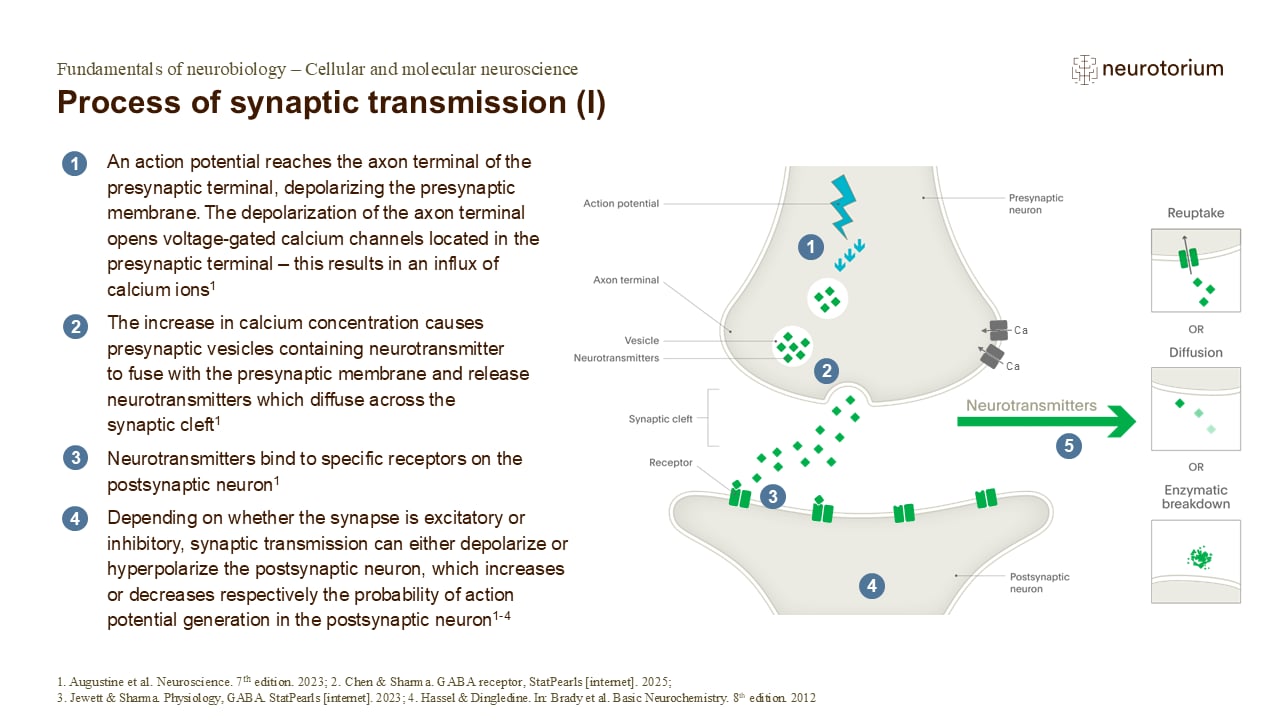
The process of chemical neurotransmission is outlined in brief on the slide. An action potential arrives at the presynaptic terminal, which causes voltage-gated calcium channels to open, leading to a rapid influx of calcium (detail not shown on slide).1 The increased calcium within the neuron terminal (which is just a transient effect) causes synaptic vesicles (membrane-enclosed sacs that store neurotransmitters) to fuse with the membrane, and release their contents into the synaptic cleft.1 The released neurotransmitters, bind to specific proteins (receptors) on the postsynaptic neuron, producing a change in the postsynaptic membrane potential.1
The effect of this binding varies depending on whether the synapse is excitatory or inhibitory: the most common type of excitatory synapse uses glutamate as a neurotransmitter, which when binding to its receptor causes an excitatory postsynaptic potential (EPSP) that has a depolarizing effect on the postsynaptic neuron.4 Inhibitory synapses typically use gamma-amino butyric acid (GABA) as a neurotransmitter, which causes an inhibitory postsynaptic potential (IPSP) that has a hyperpolarizing effect on the postsynaptic neuron.2
References:
1. Synaptic transmission. In: Augustine GJ, Groh J, Huettel S, et al. (eds). Neuroscience. 7th edition. Oxford University Press, 2023.
2. Chen RJ, Sharma S. GABA receptor. StatPearls [internet]. 2025.
3. Jewett BE, Sharma S. Physiology, GABA. StatPearls [internet]. 2023.
4. Hassel B, Dingledine R. Glutamate and glutamate receptors. In: Brady ST, Siegel CJ, Albers RW, Price DL (eds). Basic Neurochemistry: Principles of Molecular, Cellular and Medical Neurobiology. 8th edition. Academic Press, 2012.