

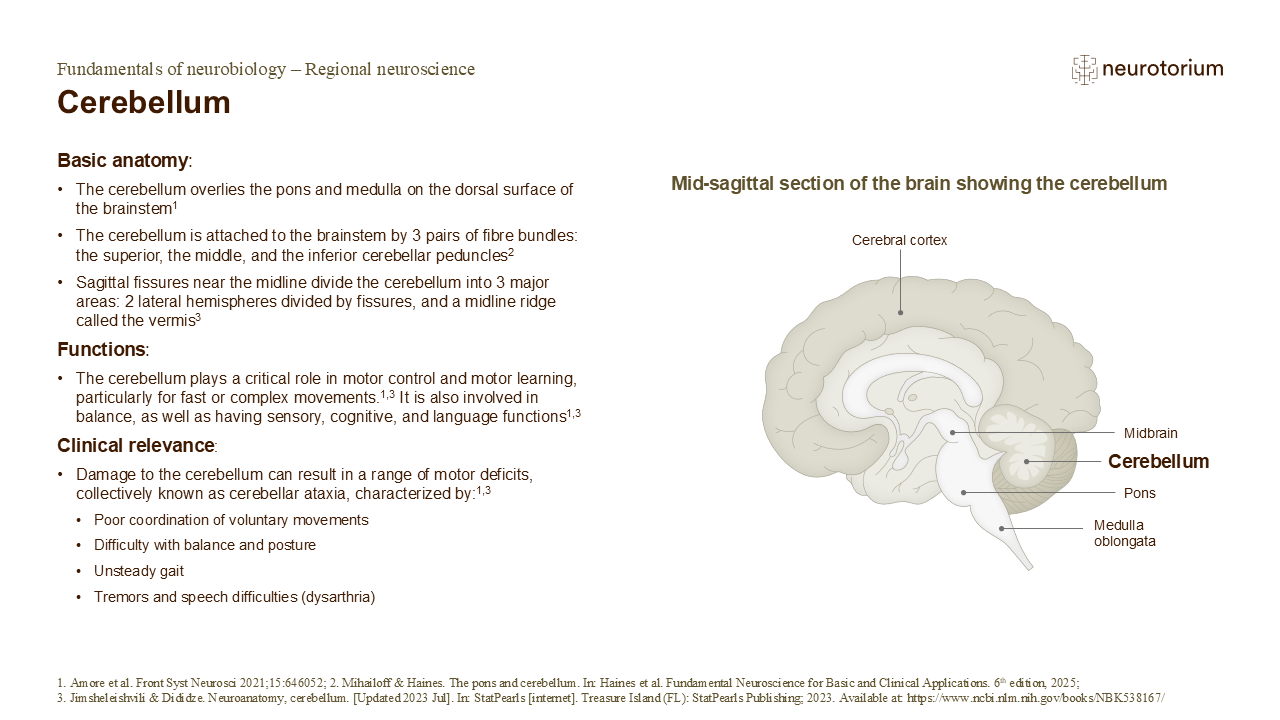
The cerebellum, located at the back of the brain beneath the cerebral cortex, has a distinctive surface featuring many folds, or folia, that increase its surface area.1,2 It is divided into three main lobes (the anterior, posterior, and flocculonodular lobes) by transverse fissures that extend through its hemispheres and central region, the vermis.1,2 Structurally, the cerebellum consists of a thin outer layer of grey matter (the cerebellar cortex) surrounding an inner core of white matter, which houses four pairs of deep cerebellar nuclei that serve as critical relay points for cerebellar output.2
References:
1. Amore G, Spoto G, Ieni A, et al. A focus on the cerebellum: from embryogenesis to an age-related clinical perspective. Front Syst Neurosci 2021; 15: 646052.
2. Mihailoff GA, Haines DE. The pons and cerebellum. In: Haines DE, Mihailoff GA, Willis MA. Fundamental Neuroscience for Basic and Clinical Applications. 6th edition, 2025. Philadelphia: Elsevier.
3. Jimsheleishvili S, Dididze M. Neuroanatomy, cerebellum. [Updated 2023 Jul]. In: StatPearls [internet]. Treasure Island (FL): StatPearls Publishing; 2023. Available at: https://www.ncbi.nlm.nih.gov/books/NBK538167/.