

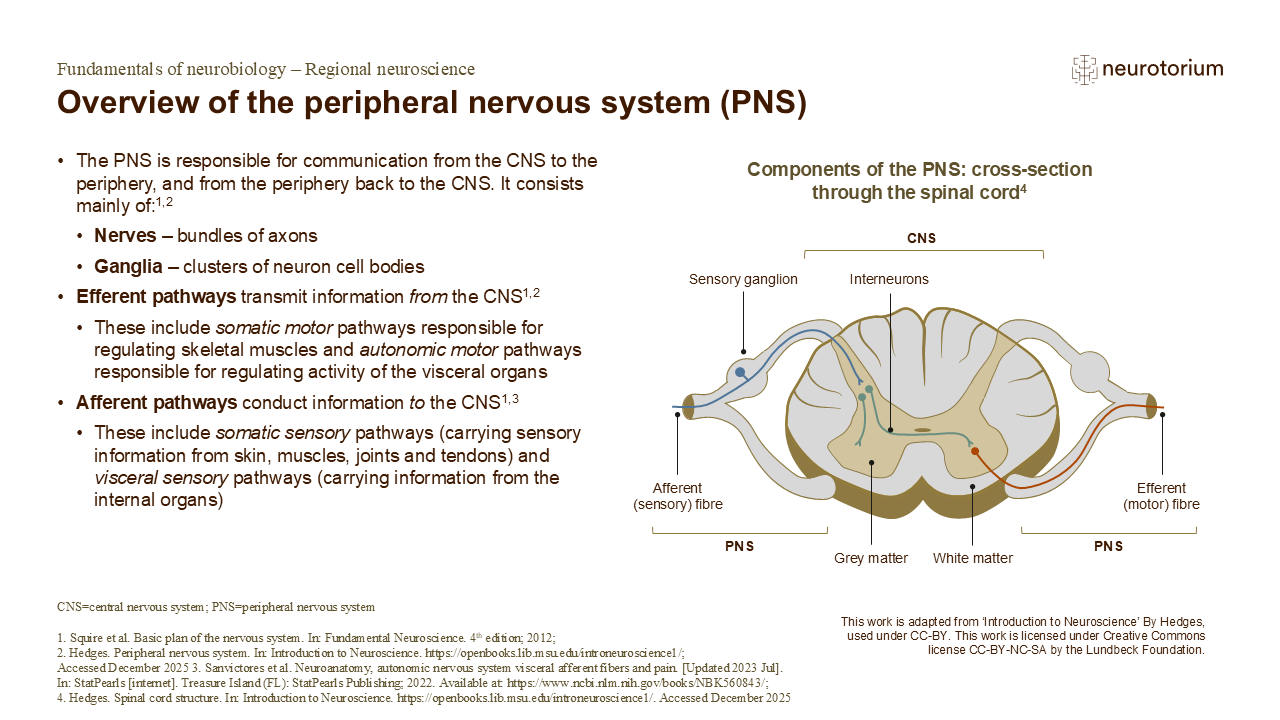
The cell bodies of efferent pathways (motor and autonomic) lie in the spinal cord of the central nervous system (CNS) and peripheral nerves contain axons from these neuronal cell bodies as well as those situated in peripheral ganglia.1,2 The central/peripheral distinction is therefore to some extent an anatomical convenience that ignores this aspect of circuit organisation.1
References:
1. Basic plan of the nervous system. In: Squire L, Berg D, Bloom FE, Lac Sd, Ghosh A, Spitzer NC. Fundamental Neuroscience. 4th edition, 2012. Burlington: Elsevier Science.
2. Hedges V. Peripheral nervous system. In: Introduction to Neuroscience. Available at: https://openbooks.lib.msu.edu/introneuroscience1/. Accessed December 2025.
3. Sanvictores T, Jozsa F, Tadi P. Neuroanatomy, autonomic nervous system visceral afferent fibers and pain. [Updated 2023 Jul]. In: StatPearls [internet]. Treasure Island (FL): StatPearls Publishing; 2022. Available at: https://www.ncbi.nlm.nih.gov/books/NBK560843/.
4. Hedges V. Spinal cord structure. In: Introduction to Neuroscience. Available at: https://openbooks.lib.msu.edu/introneuroscience1/. Accessed December 2025.