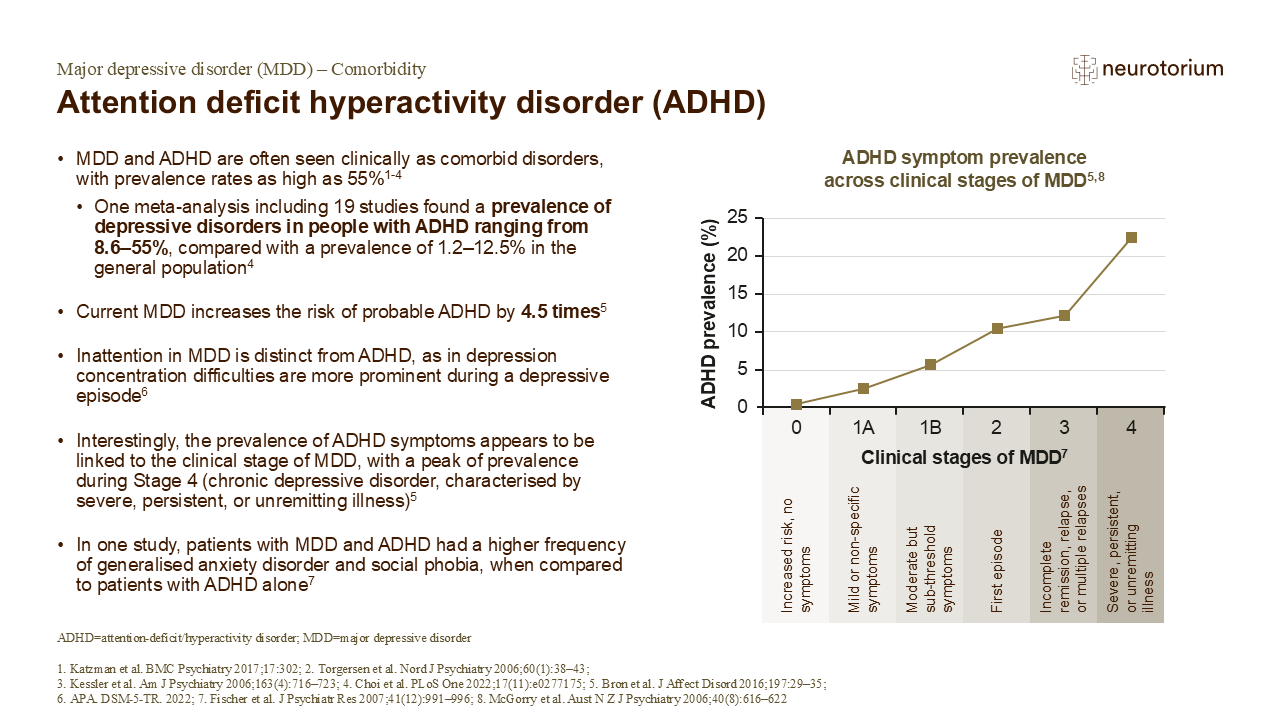
The essential feature of ADHD is a persistent pattern of inattention and/or hyperactivity that interferes with functioning or development.6 For example, wandering off task, or difficulty sustaining focus, and excessive motor activity, or fidgeting, or talkativeness.6 The diagnosis must be separated from that of MDD, because some of the clinical features are shared.6 ADHD is a distinct diagnosis from MDD because, in MDD, the difficulty with concentration is a component of the mood disorder, and becomes prominent during a depressive episode.6
References:
1.Katzman MA, Bilkey TS, Chokka PR, et al. Adult ADHD and comorbid disorders: clinical implications of a dimensional approach. BMC Psychiatry 2017; 17: 302.
2.Torgersen T, Gjervan B, Rasmussen K. ADHD in adults: a study of clinical characteristics, impairment and comorbidity. Nord J Psychiatry 2006; 60 (1): 38–43.
3.Kessler RC, Adler L, Barkley R, et al. The prevalence and correlates of adult ADHD in the United States: results from the National Comorbidity Survey Replication. Am J Psychiatry 2006; 163 (4): 716–723.
4.Choi WS, Woo YS, Wang SM, et al. The prevalence of psychiatric comorbidities in adult ADHD compared with non-ADHD populations: a systematic literature review. PLoS One 2022; 17 (11): e0277175.
5.Bron TI, Bijlenga D, Verduijn J, et al. Prevalence of ADHD symptoms across clinical stages of major depressive disorder. J Affect Disord 2016; 197: 29–35.
6.American Psychiatric Association. Diagnostic and Statistical Manual of Mental Disorders. Fifth Edition – text revision. © American Psychiatric Association, 2022.
7.Fischer AG, Bau CH, Grevet EH, et al. The role of comorbid major depressive disorder in the clinical presentation of adult ADHD. J Psychiatr Res 2007; 41 (12): 991–996.
8.McGorry PD, Hickie IB, Yung AR, et al. Clinical staging of psychiatric disorders: a heuristic framework for choosing earlier, safer and more effective interventions. Aust N Z J Psychiatry 2006; 40 (8): 616–622.