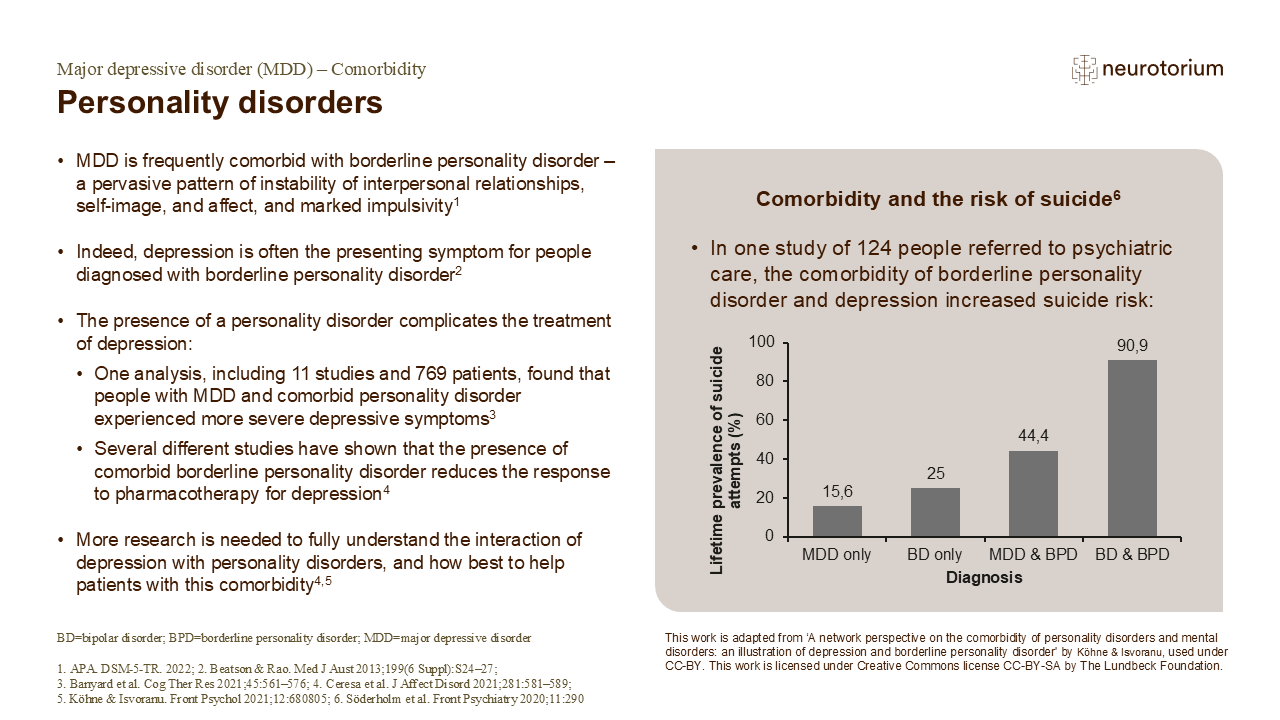
Personality disorders include a range of different diagnoses that describe a pervasive and inflexible pattern of inner experience and behaviour that markedly deviates from the norms and expectations of the individual’s culture.1 The disorder is typically stable over time, with onset in adolescence or early adulthood, and as a disorder is a source of distress or impairment for the individual.1 A clinician should be wary of diagnosing a personality disorder during a depressive episode, because of the partial overlap in symptomatology.1
References:
1.American Psychiatric Association. Diagnostic and Statistical Manual of Mental Disorders. Fifth Edition – text revision. © American Psychiatric Association, 2022.
2.Beatson JA, Rao S. Depression and borderline personality disorder. Med J Aust 2013; 199 (6 Suppl): S24–27.
3.Banyard H, Behn AJ, Delgadillo J. Personality disorders and their relation to treatment outcomes in cognitive behavioural therapy for depression: a systematic review and meta-analysis. Cog Ther Res 2021; 45: 561–576.
4.Ceresa A, Esposito CM, Buoli M. How does borderline personality disorder affect management and treatment response of patients with major depressive disorder? A comprehensive review. J Affect Disord 2021; 281: 581–589.
5.Köhne ACJ, Isvoranu AM. A network perspective on the comorbidity of personality disorders and mental disorders: an illustration of depression and borderline personality disorder. Front Psychol 2021; 12: 680805.
6.Söderholm JJ, Socada JL, Rosenström T, et al. Borderline personality disorder with depression confers significant risk of suicidal behavior in mood disorder patients – a comparative study. Front Psychiatry 2020; 11: 290.