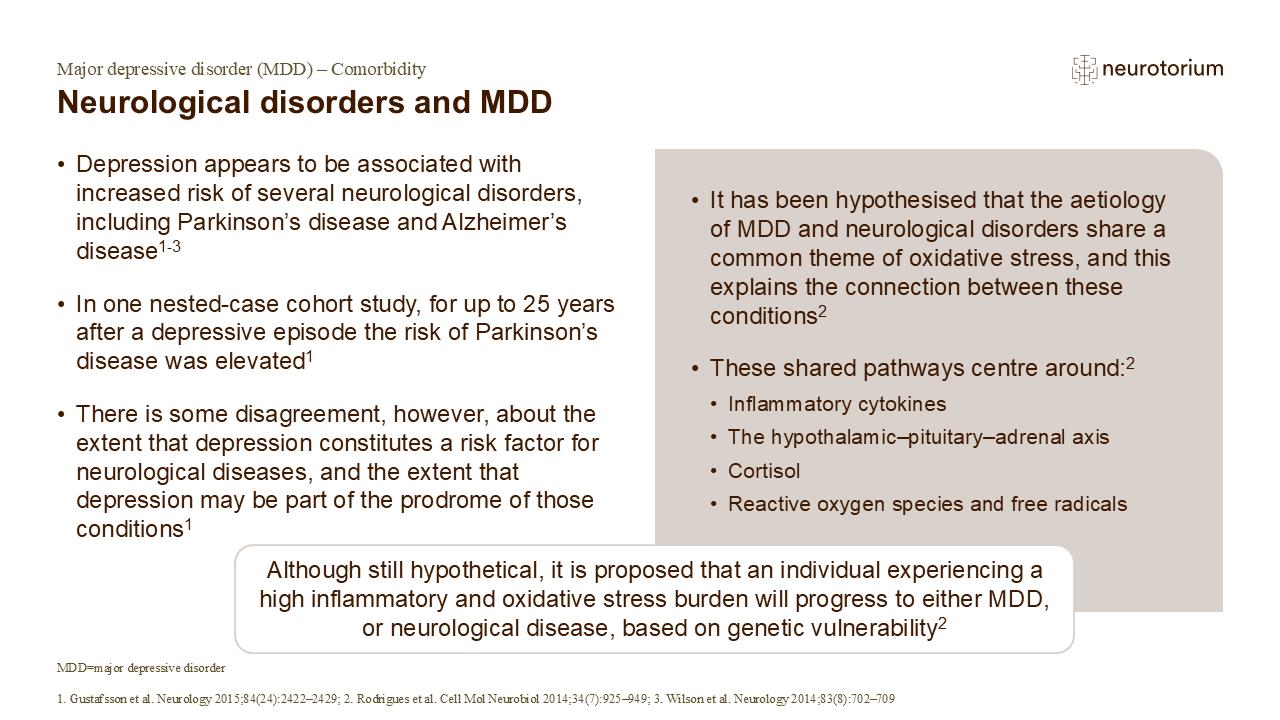
Disentangling the various comorbidities of MDD is a herculean challenge, because many conditions are interrelated.4,5 For example, depression appears to enhance the risk of developing Alzheimer’s disease, but also of type-2 diabetes.4 However, type-2 diabetes is itself a risk factor for Alzheimer’s disease.4 Investigating the role of depression as a risk factor for Alzheimer’s disease therefore involves attempting to control for the potentially confounding influence of type-2 diabetes.
It appears that patients with depression are at an increased risk of developing various dementias and Parkinson’s disease.1-3 In one study of >1,700 older individuals, the presence of depressive symptoms was associated with the rate of cognitive decline observed.3 However, it is not clear how the presence of depression contributes to cognitive decline.3
References:
1.Gustafsson H, Nordström A, Nordström P. Depression and subsequent risk of Parkinson disease: a nationwide cohort study. Neurology 2015; 84 (24): 2422–2429.
2.Rodrigues R, Petersen RB, Perry G. Parallels between major depressive disorder and Alzheimer’s disease: role of oxidative stress and genetic vulnerability. Cell Mol Neurobiol 2014; 34 (7): 925–949.
3.Wilson RS, Capuano AW, Boyle PA, et al. Clinical–pathologic study of depressive symptoms and cognitive decline in old age. Neurology 2014; 83 (8): 702–709.
4.Cha DS, Carvalho AF, Rosenblat JD, et al. Major depressive disorder and type II diabetes mellitus: mechanisms underlying risk for Alzheimer’s disease. CNS Neurol Disord Drug Targets 2014; 13 (10): 1740–1749.
5.American Psychiatric Association. Diagnostic and Statistical Manual of Mental Disorders. Fifth Edition – text revision. © American Psychiatric Association, 2022.