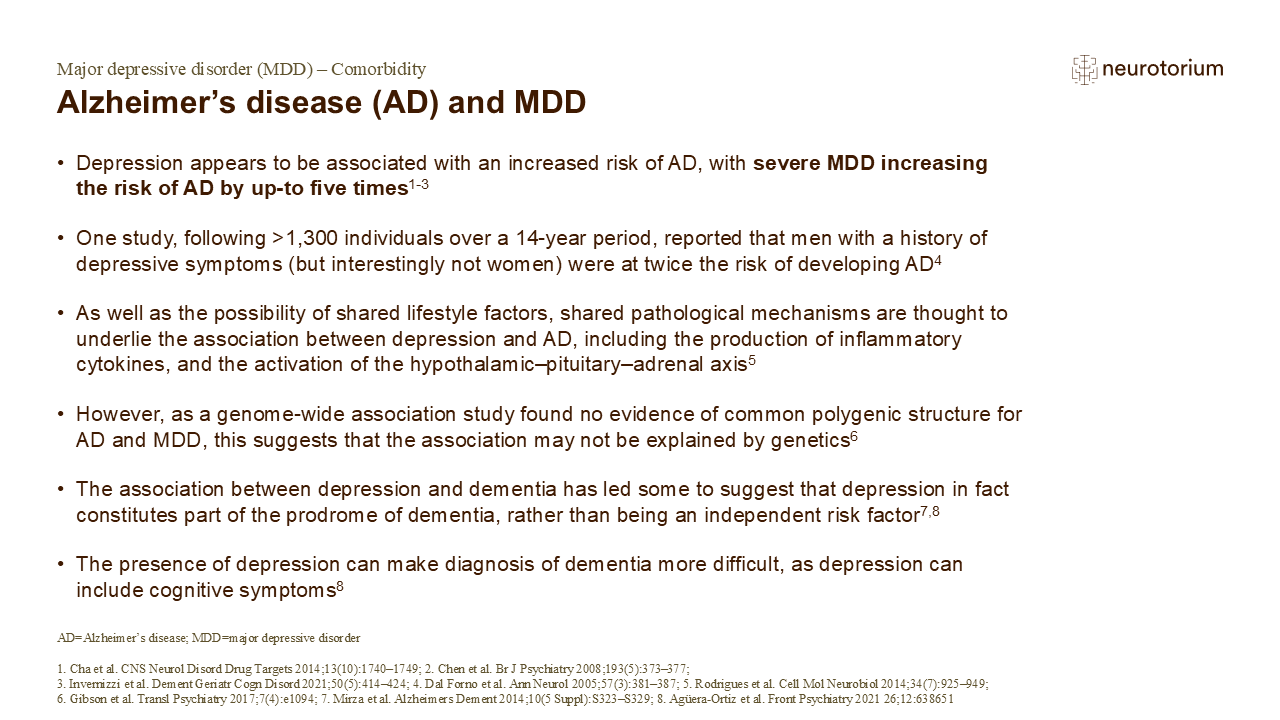
Whether or not, and to what extent, depression is a risk factor for, or a constituent part of the prodrome of, dementia, is still a contentious issue.1,7 One study followed >4,300 non-demented individuals for 13.7 years, and tracked the development of dementia and depressive symptoms.7 Of the total sample, 582 patients developed dementia within the timeframe of the study.7 Compared to those without depressive symptoms, those with depressive symptoms had an 8% increased risk of developing dementia.7 However, in order to further interrogate the data, the authors analysed the effect of the time interval between depressive symptoms and dementia onset in their results.7 The risk of dementia was highest in the short-term following depression, and reduced, according to the length of the time interval, to zero risk beyond ten years.7 These observations suggest that depression is part of the dementia prodrome, rather than being an independent risk factor.7 But, as ever, more research is needed to fully elucidate the relationship.
References:
1.Cha DS, Carvalho AF, Rosenblat JD, et al. Major depressive disorder and type II diabetes mellitus: mechanisms underlying risk for Alzheimer’s disease. CNS Neurol Disord Drug Targets 2014; 13 (10): 1740–1749.
2.Chen R, Hu Z, Wei L, et al. Severity of depression and risk for subsequent dementia: cohort studies in China and the UK. Br J Psychiatry 2008; 193 (5): 373–377.
3.Invernizzi S, Simoes Loureiro I, Kandana Arachchige KG, Lefebvre L. Late-life depression, cognitive impairment, and relationship with Alzheimer’s disease. Dement Geriatr Cogn Disord 2021; 50 (5): 414–424.
4.Dal Forno G, Palermo MT, Donohue JE, et al. Depressive symptoms, sex, and risk for Alzheimer’s disease. Ann Neurol 2005; 57 (3): 381–387.
5.Rodrigues R, Petersen RB, Perry G. Parallels between major depressive disorder and Alzheimer’s disease: role of oxidative stress and genetic vulnerability. Cell Mol Neurobiol 2014; 34 (7): 925–949.
6.Gibson J, Russ TC, Adams MJ, et al. Assessing the presence of shared genetic architecture between Alzheimer’s disease and major depressive disorder using genome-wide association data. Transl Psychiatry 2017; 7 (4): e1094.
7.Mirza SS, de Bruijn RFAG, Direk N, et al. Depressive symptoms predict incident dementia during short- but not long-term follow-up period. Alzheimers Dement 2014; 10 (5 Suppl): S323–S329.
8.Agüera-Ortiz L, García-Ramos R, Grandas Pérez FJ, et al. Depression in Alzheimer’s disease: a Delphi consensus on etiology, risk factors, and clinical management. Front Psychiatry 2021 26; 12: 638651.