

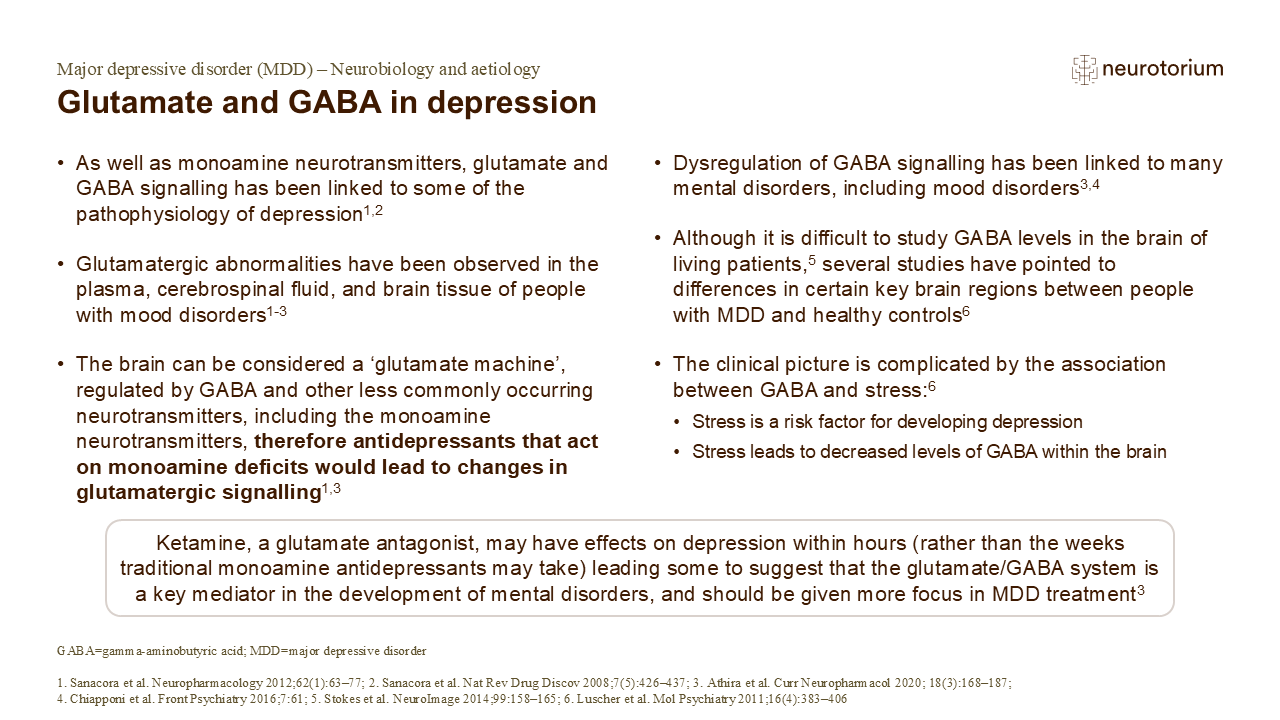
Clinical and preclinical studies have shown that depression and chronic stress adversely impact both GABA and glutamate pathways, with clinical studies showing reductions in the volume of prefrontal cortex and hippocampus, reductions in the levels of synaptic markers, decreased somatostatin interneuron markers, and decreased levels of glutamic acid decarboxylase.7 Chronic stress has been shown to change the structure and reduce the function of glutamate neurons; the resulting atrophy of glutamate neurons is thought to contribute to the reduction in volume of cortical and limbic structures observed in depression.7
References:
- Sanacora G, Treccani G, Popoli M. Towards a glutamate hypothesis of depression: an emerging frontier of neuropsychopharmacology for mood disorders. Neuropharmacology 2012; 62 (1): 63–77.
- Sanacora G, Zarate CA, Krystal JH, Manji HK. Targeting the glutamatergic system to develop novel, improved therapeutics for mood disorders. Nat Rev Drug Discov 2008; 7 (5): 426–437.
- Athira KV, Bandopadhyay S, Samudrala PK, et al. An overview of the heterogeneity of major depressive disorder: current knowledge and future prospective. Curr Neuropharmacol 2020; 18 (3): 168–187.
- Chiapponi C, Piras F, Piras F, et al. GABA system in schizophrenia and mood disorders: a mini review on third-generation imaging studies. Front Psychiatry 2016; 7: 61.
- Stokes PRA, Myers JF, Kalk NJ, et al. Acute increases in synaptic GABA detectable in the living human brain: A [11C]Ro15-4513 PET study. NeuroImage 2014; 99: 158–165.
- Luscher B, Shen Q, Sahir N. The GABAergic deficit hypothesis of major depressive disorder. Mol Psychiatry 2011; 16 (4): 383–406.
- Duman RS, Sanacora G, Krystal JH. Altered connectivity in depression: GABA and glutamate neurotransmitter deficits and reversal by novel treatments. Neuron 2019; 102 (1): 75–90.