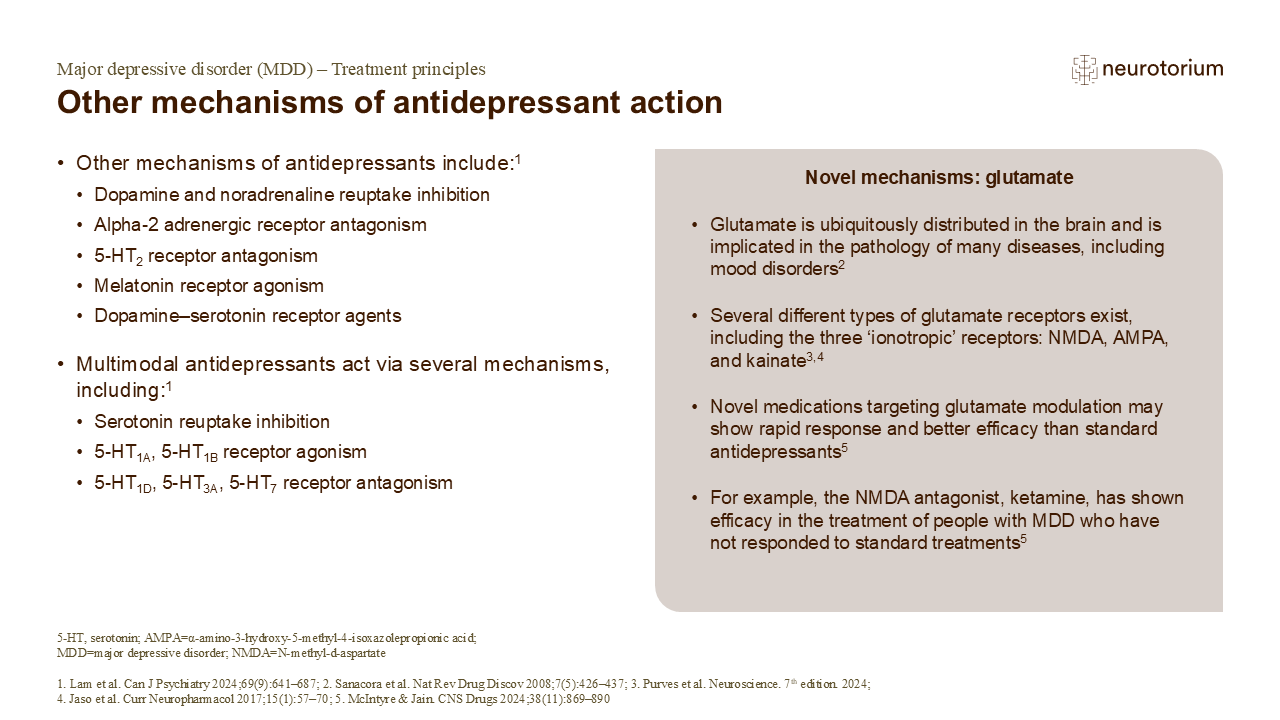
Changes in glutamate physiology have been detected in patients with MDD relative to control individuals.2 However, because glutamate is found throughout the body, it can be hard to pinpoint the exact source of glutamate in peripheral tissues.2 Methods have moved on to using techniques, such as magnetic resonance spectroscopy (MRS), which can be used to measure the glutamate content within the brain.2
Glutamate receptors in the brain are separated into two classes:3,4
- ionotropic receptors that function by allowing movement of cations across the membrane (e.g., calcium, sodium)
- metabotropic receptors, which are seven-transmembrane domain receptors that either activate or inhibit signalling pathways within the cell.
References:
1.Lam RW, Kennedy SH, Adams C, et al. Canadian Network for Mood and Anxiety Treatments (CANMAT) 2023 update on clinical guidelines for management of major depressive disorder in adults: Réseau canadien pour les traitements de l’humeur et de l’anxiété (CANMAT) 2023: mise à jour des lignes directrices cliniques pour la prise en charge du trouble dépressif majeur chez les adultes. Can J Psychiatry 2024; 69 (9): 641–687.
2.Sanacora G, Zarate CA, Krystal JH, Manji HK. Targeting the glutamatergic system to develop novel, improved therapeutics for mood disorders. Nat Rev Drug Discov 2008; 7 (5): 426–437.
3.Purves D, Augustine GJ, Groh J, et al. (eds). Neuroscience. 7th Edition. © Oxford University Press, 2024.
4.Jaso BA, Niciu MJ, Iadarola ND, et al. Therapeutic modulation of glutamate receptors in major depressive disorder. Curr Neuropharmacol 2017; 15 (1): 57–70.
5.McIntyre RS, Jain R. Glutamatergic modulators for major depression from theory to clinical use. CNS Drugs 2024; 38 (11): 869–890.