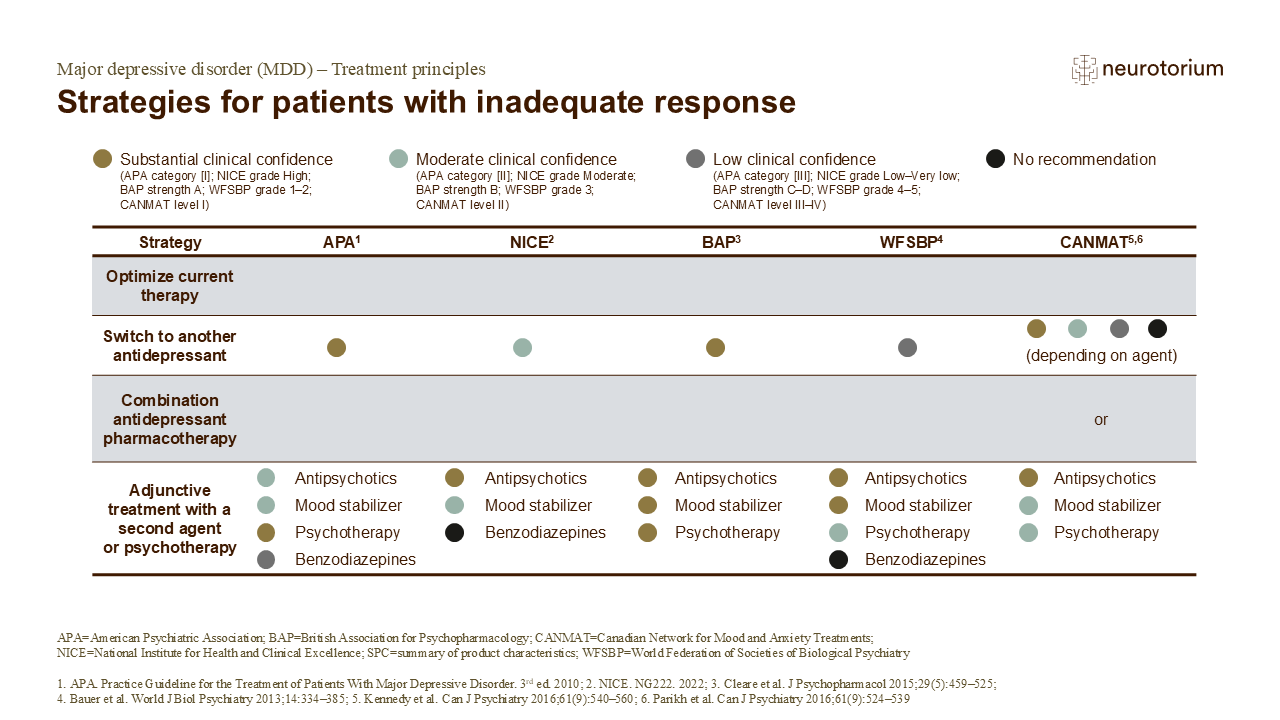
This slide compares the guideline recommendations for patients with inadequate response to antidepressant monotherapy from four internationally-recognised bodies:
1.American Psychiatric Association (APA)1
2.National Institute for Health and Care Excellence (NICE)2
3.British Association for Psychopharmacology (BAP)3
4.World Federation of Societies of Biological Psychiatry (WFSBP)4
5.Canadian Network for Mood and Anxiety Treatments (CANMAT)5,6
Each body rates their guideline recommendations according to the level of clinical evidence available.
There are four categories, ranked from the strongest to the least evidence:
- Substantial clinical confidence (strongest supporting evidence)
- Moderate clinical confidence
- Low clinical confidence
- No clinical confidence (no or little supporting evidence)
References:
1.American Psychiatric Association. Practice Guideline for the Treatment of Patients with Major Depressive Disorder. 3rd Edition. © American Psychiatric Association, 2010. http://psychiatryonline.org/guidelines.aspx. Accessed April 2025.
2.National Institute for Health and Care Excellence. Depression in adults: treatment and management. Guideline 222, June 2022. © NICE, June 2022, updated September 2024. https://www.nice.org.uk/guidance/ng222. Accessed April 2025.
3.Cleare A, Pariante CM, Young AH, et al. Evidence-based guidelines for treating depressive disorders with antidepressants: a revision of the 2008 British Association for Psychopharmacology guidelines. J Psychopharmacol 2015; 29 (5): 459–525.
4.Bauer M, Pfennig A, Severus E, et al.; World Federation of Societies of Biological Psychiatry (WFSBP) Task Force on Unipolar Depressive Disorders. WFSBP guidelines for biological treatment of unipolar depressive disorders, part 1: update 2013 on the acute and continuation treatment of unipolar depressive disorders. World J Biol Psychiatry 2013; 14 (5): 334–385.
5.Kennedy SH, Lam RW, McIntyre RS, et al. Canadian Network for Mood and Anxiety Treatments (CANMAT) 2016 clinical guidelines for the management of adults with major depressive disorder: section 3. Pharmacological treatments. Can J Psychiatry 2016; 61 (9): 540–560.
6.Parikh SV, Quilty LC, Ravitz P, et al. Canadian Network for Mood and Anxiety Treatments (CANMAT) 2016 clinical guidelines for the management of adults with major depressive disorder: section 2. Psychological treatments. Can J Psychiatry 2016; 61 (9): 524–539.