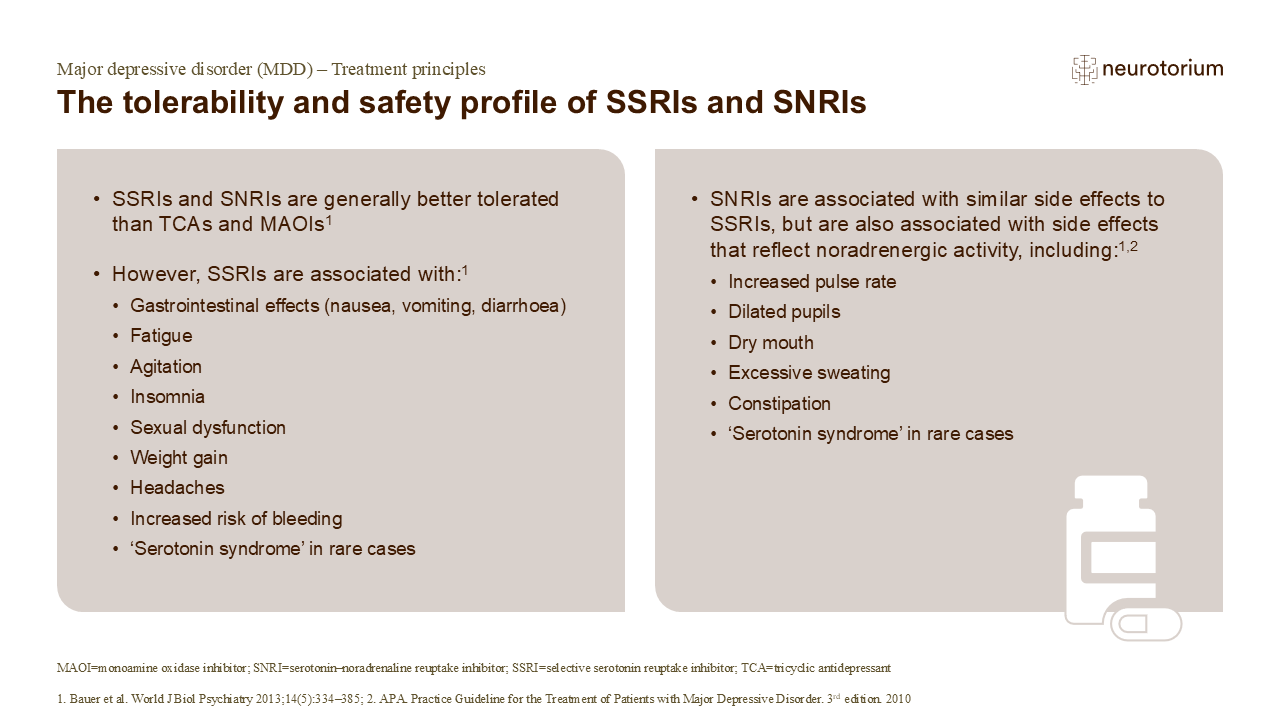
SSRIs are generally well tolerated. However, as a class, SSRIs are associated with a spectrum of adverse effects.1 The range of adverse effects varies between individual agents within the class; although all drugs within the SSRI class share the same mechanism of action (inhibition of serotonin reuptake), the secondary receptor profiles are different, leading to differences in propensity to cause certain adverse reactions and differences in efficacy.3
The SNRI side-effect profile is similar to that seen with SSRIs, with the addition of effects that reflect the noradrenergic activity of agents within this class, as outlined on the slide.1,2,4
References:
1.Bauer M, Pfennig A, Severus E, et al.; World Federation of Societies of Biological Psychiatry (WFSBP) Task Force on Unipolar Depressive Disorders. WFSBP guidelines for biological treatment of unipolar depressive disorders, part 1: update 2013 on the acute and continuation treatment of unipolar depressive disorders. World J Biol Psychiatry 2013; 14 (5): 334–385.
2.American Psychiatric Association. Practice Guideline for the Treatment of Patients with Major Depressive Disorder. 3rd Edition. © American Psychiatric Association, 2010. http://psychiatryonline.org/guidelines.aspx. Accessed April 2025.
3.Stahl SM. Stahl’s Essential Psychopharmacology. Neuroscientific Basis and Practical Applications. 5th Edition. © Cambridge University Press, 2021.
4.Lam RW, Kennedy SH, Adams C, et al. Canadian Network for Mood and Anxiety Treatments (CANMAT) 2023 update on clinical guidelines for management of major depressive disorder in adults: Réseau canadien pour les traitements de l’humeur et de l’anxiété (CANMAT) 2023: mise à jour des lignes directrices cliniques pour la prise en charge du trouble dépressif majeur chez les adultes. Can J Psychiatry 2024; 69 (9): 641–687.