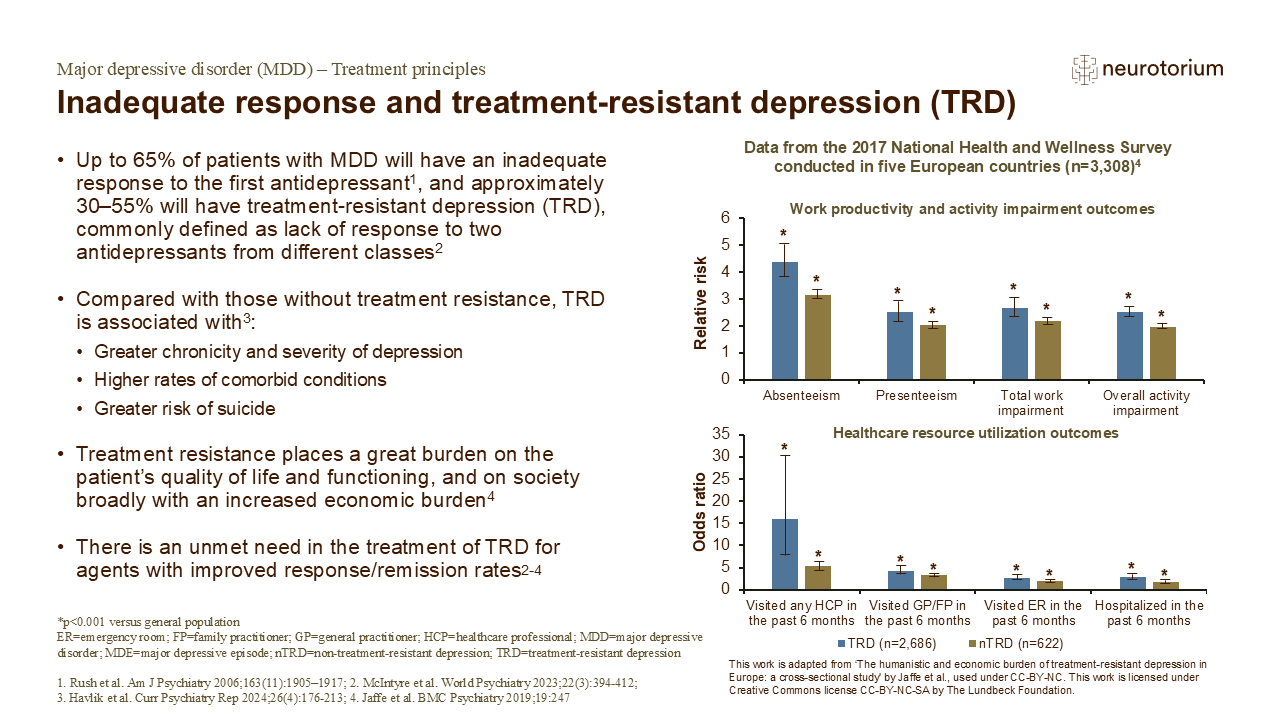
The slide explains how patients with MDD who do not respond adequately to antidepressant treatment are at risk of worse outcomes, including an increased risk of relapse,5 and a prolonged loss of quality of life, functional status, and well-being.6
Response is generally defined as a ≥50% improvement from baseline in a depression rating scale score; partial response is most frequently defined as an improvement from baseline of ≥25 and <50%; no standard definition exists for non-response.7 In the real-world STAR*D study, approximately half of patients did not achieve response with a first-line antidepressant, and three quarters of patients did not achieve response with second-line antidepressant monotherapy.1 Antidepressant drugs are also limited in terms of sustaining remission; in the real-world STAR*D study, >90% of the patients who achieved remission subsequently relapsed or dropped out of the study over 12 months of continuing care.8
There is an unmet need, therefore, for novel treatments that improve the response and remission rates in patients with MDD.9
References:
1.Rush AJ, Trivedi MH, Wisniewski SR, et al. Acute and longer-term outcomes in depressed outpatients requiring one or several treatment steps: a STAR*D report. Am J Psychiatry 2006; 163 (11): 1905–1917.
2.McIntyre RS, Alsuwaidan M, Baune BT, et al. Treatment-resistant depression: definition, prevalence, detection, management, and investigational interventions. World Psychiatry 2023; 22 (3): 394–414.
3.Havlik JL, Wahid S, Teopiz KM, et al. Recent advances in the treatment of treatment-resistant depression: A narrative review of literature published from 2018 to 2023. Curr Psychiatry Rep 2024; 26 (4): 176–213.
4.Jaffe DH, Rive B, Denee TR. The humanistic and economic burden of treatment-resistant depression in Europe: a cross-sectional study. BMC Psychiatry 2019; 19: 247.
5.Pintor L, Torres X, Navarro V, et al. Is the type of remission after a major depressive episode an important risk factor to relapses in a 4-year follow up? J Affect Disord 2004; 82 (2): 291–296.
6.Mauskopf JA, Simon GE, Kalsekar A, et al. Nonresponse, partial response, and failure to achieve remission: humanistic and cost burden in major depressive disorder. Depress Anxiety 2009; 26 (1): 83–97.
7.Nierenberg AA, DeCecco LM. Definitions of antidepressant treatment response, remission, nonresponse, partial response, and other relevant outcomes: a focus on treatment-resistant depression. J Clin Psychiatry 2001; 62 (Suppl 16): 5–9.
8.Pigott HE, Leventhal AM, Alter GS, Boren JJ. Efficacy and effectiveness of antidepressants: current status of research. Psychother Psychosom 2010; 79 (5): 267–279.
9.Möller HJ. Outcomes in major depressive disorder: the evolving concept of remission and its implications for treatment. World J Biol Psychiatry 2008; 9 (2): 102–114.