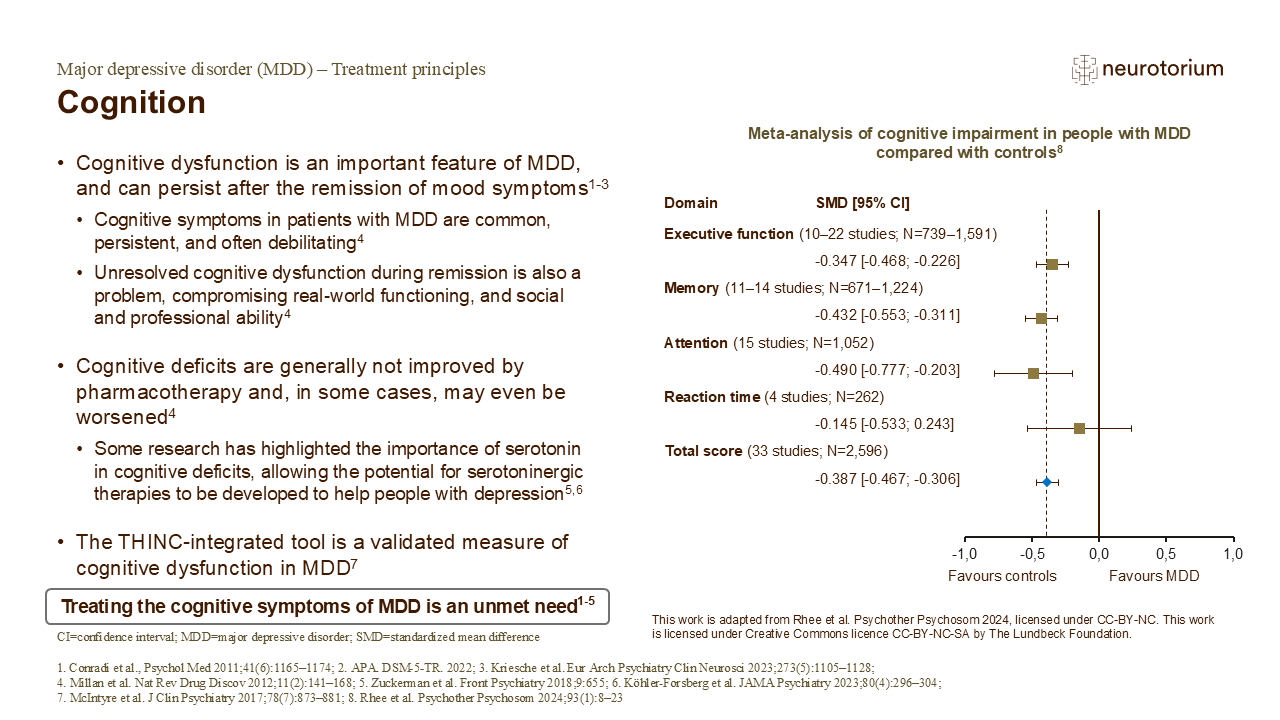
Cognitive dysfunction is now a well-established component of MDD, both as an independent part of the symptom complex and as a residual symptom persisting when mood symptoms are in remission.1,2,4,9 In a three-year prospective study of patients treated for MDD, patients spent 44% of the time when not experiencing a major depressive episode still experiencing cognitive problems.1 The proportion of time experiencing cognitive problems when also experiencing a major depressive episode was 94%.1 This shows that cognitive dysfunction associated with MDD (specifically poor concentration and indecisiveness) is a common residual symptom of the condition.1
Despite this, of the two most widely used and validated scales for MDD – the Montgomery–Åsberg Depression Rating Scale (MADRS) and the Hamilton Depression Rating Scale (HAM-D) – only one scale includes a question on cognitive functioning – the MADRS item ‘concentration’.10,11 This means that analysing the cognitive functioning of patients with MDD requires the use of a specific scale, or neuropsychiatric testing. One example of a specialised, validated scale that is sensitive to cognitive dysfunction in adults with MDD is the THINC-integrated tool, which includes variants of the Choice Reaction Time Identification Task (IDN), One-Back Test (OBK), Digit Symbol Substitution Test (DSST), Trail Making Test-Part B (TMT-B), and the Perceived Deficits Questionnaire for Depression-5-item (PDQ-5-D).7
References:
1.Conradi HJ, Ormel J, de Jonge P. Presence of individual (residual) symptoms during depressive episodes and periods of remission: a 3-year prospective study. Psychol Med 2011; 41 (6): 1165–1174.
2.American Psychiatric Association. Diagnostic and Statistical Manual of Mental Disorders. 5th Edition – Text Revision (DSM-5-TR). © American Psychiatric Association, 2022.
3.Kriesche D, Woll CFJ, Tschentscher N, et al. Neurocognitive deficits in depression: a systematic review of cognitive impairment in the acute and remitted state. Eur Arch Psychiatry Clin Neurosci 2023; 273 (5): 1105–1128.
4.Millan MJ, Agid Y, Brüne M, et al. Cognitive dysfunction in psychiatric disorders: characteristics, causes and the quest for improved therapy. Nat Rev Drug Discov 2012; 11 (2): 141–168.
5.Zuckerman H, Pan Z, Park C, et al. Recognition and treatment of cognitive dysfunction in major depressive disorder. Front Psychiatry 2018; 9: 655.
6.Köhler-Forsberg K, Dam VH, Ozenne B, et al. Serotonin 4 receptor brain binding in major depressive disorder and association with memory dysfunction. JAMA Psychiatry 2023; 80 (4): 296–304.
7.McIntyre RS, Best MW, Bowie CR, et al. The THINC-Integrated Tool (THINC-it) screening assessment for cognitive dysfunction: validation in patients with major depressive disorder. J Clin Psychiatry 2017; 78 (7): 873–881.
8.Rhee TG, Shim SR, Manning KJ, et al. Neuropsychological Assessments of Cognitive Impairment in Major Depressive Disorder: A Systematic Review and Meta-Analysis with Meta-Regression. Psychother Psychosom 2024; 93 (1): 8–23.
9.Rund BR, Sundet K, Asbjørnsen, et al. Neuropsychological test profiles in schizophrenia and non-psychotic depression. Acta Psychiatr Scand 2006; 113 (4): 350–359.
10.Hamilton M. Development of a rating scale for primary depressive illness. Br J Soc Clin Psychol 1967; 6 (4): 278–296.
11.Montgomery SA, Asberg M. A new depression scale designed to be sensitive to change. Br J Psychiatry 1979; 134: 382–389.