

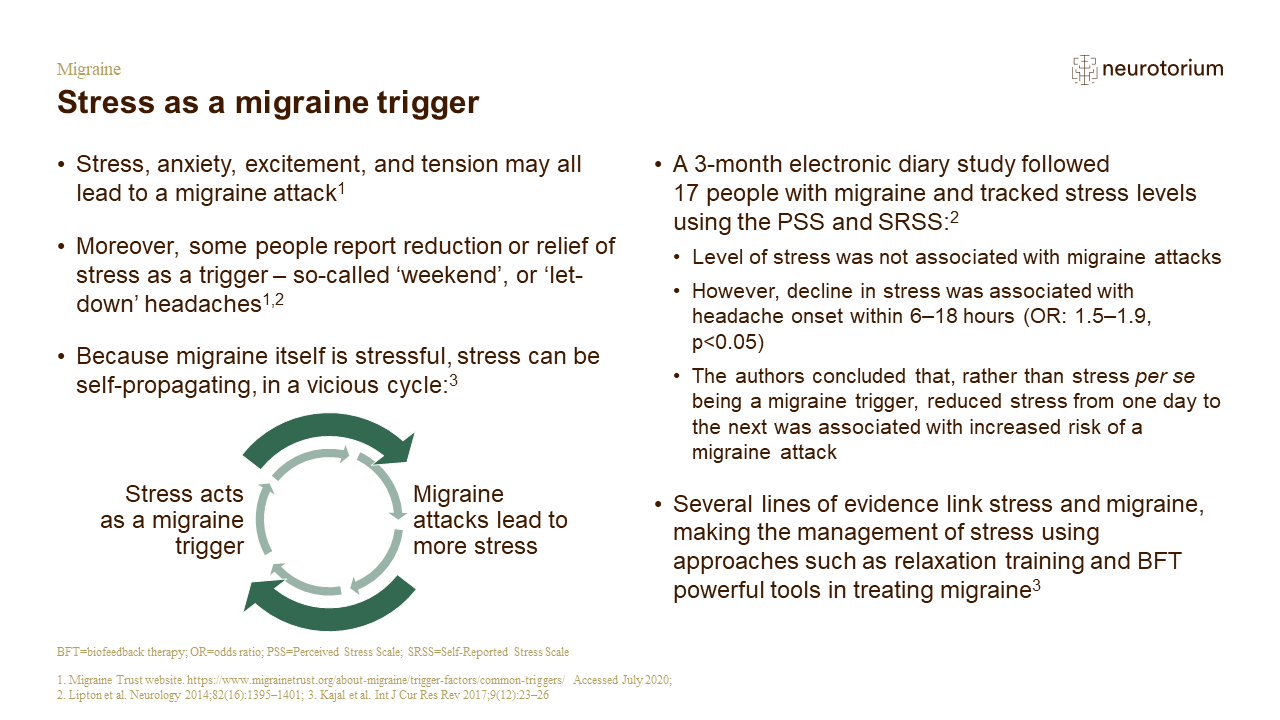
Stress is an important migraine trigger.[Kajal et al., 2017] Several different patterns of stress leading to a migraine attack have been described in the literature:[Spierings et al., 2014; Spierings et al., 1997]
- stress in the afternoon, leading to a headache in the evening or during the night
- stress extending into the evening, leading to the patient waking up the next morning feeling tired and developing a headache during that morning
- stress extending into the evening, and having an arousing effect, whereby the person still feels stressed the next morning and develops a headache during the following evening.
Other references used on slide:
Lipton RB, Buse DC, Hall CB, et al. Reduction in perceived stress as a migraine trigger: testing the “let-down headache” hypothesis. Neurology 2014; 82 (16): 1395–1401.
Migraine Trust website. https://www.migrainetrust.org/about-migraine/trigger-factors/common-triggers/. Accessed July 2020.