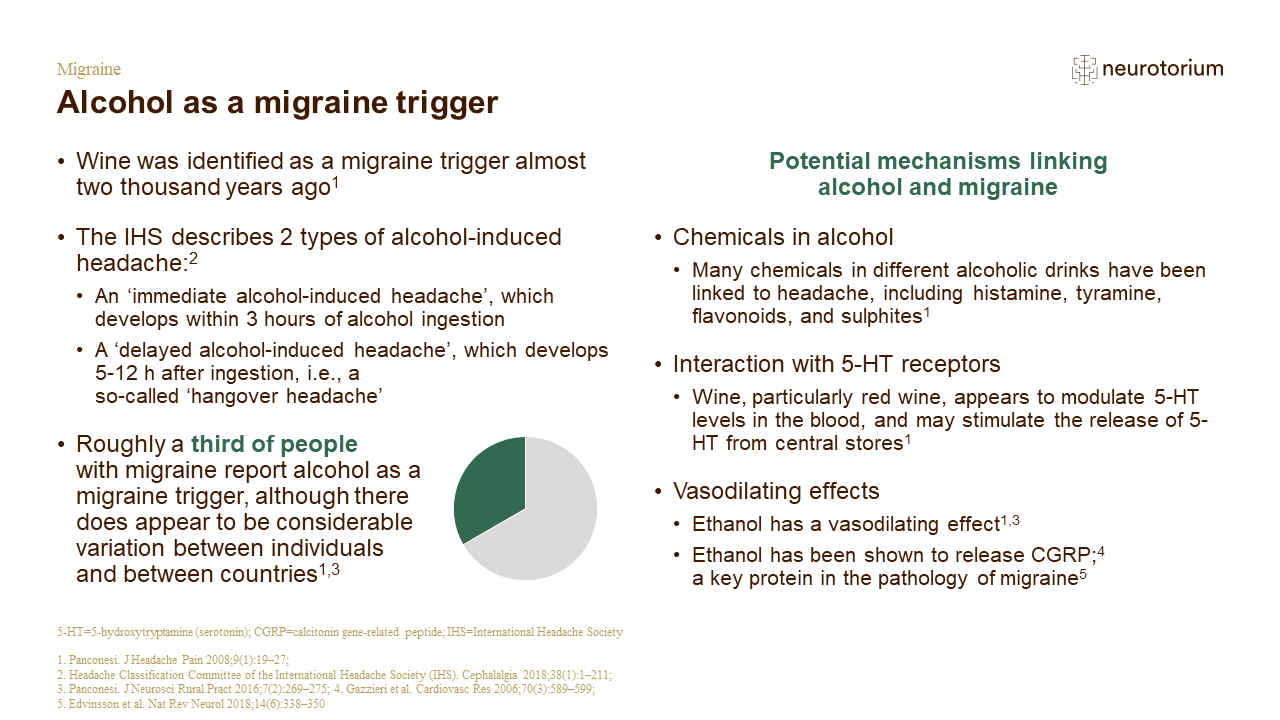
Alcohol is identified as a headache trigger in roughly a third of people with migraine, and many mechanisms have been hypothesised to underly this connection.[Panconesi, 2008; Panconesi, 2016; Onderwater et al., 2019] Why some people with migraine do not experience alcohol as a migraine trigger is unknown. The link between alcohol and CGRP is an interesting avenue of research; animal studies have suggested that CGRP release may be caused by alcohol,[Panconesi, 2016; Gazzieri et al., 2006] but more research is needed to understand the connection.
References:
Gazzieri D, Trevisani M, Tarantini F, et al. Ethanol dilates coronary arteries and increases coronary flow via transient receptor potential vanilloid 1 and calcitonin gene-related peptide. Cardiovasc Res 2006; 70 (3): 589–599.
Onderwater GLJ, van Oosterhout WPJ, Schoonman GG, et al. Alcoholic beverages as trigger factor and the effect on alcohol consumption behavior in patients with migraine. Eur J Neurol 2019; 26 (4): 588–595.
Panconesi A. Alcohol and migraine: trigger factor, consumption, mechanisms. A review. J Headache Pain 2008; 9 (1): 19–27.
Panconesi A. Alcohol-induced headaches: evidence for a central mechanism? J Neurosci Rural Pract 2016; 7 (2): 269–275.
Other references used on slide:
Edvinsson L, Haanes KA, Warfvinge K, Krause DN. CGRP as the target of new migraine therapies – successful translation from bench to clinic. Nat Rev Neurol 2018; 14 (6): 338–350.
Headache Classification Committee of the International Headache Society (IHS). The International Classification of Headache Disorders, 3rd edition. Cephalalgia 2018; 38 (1): 1–211.