

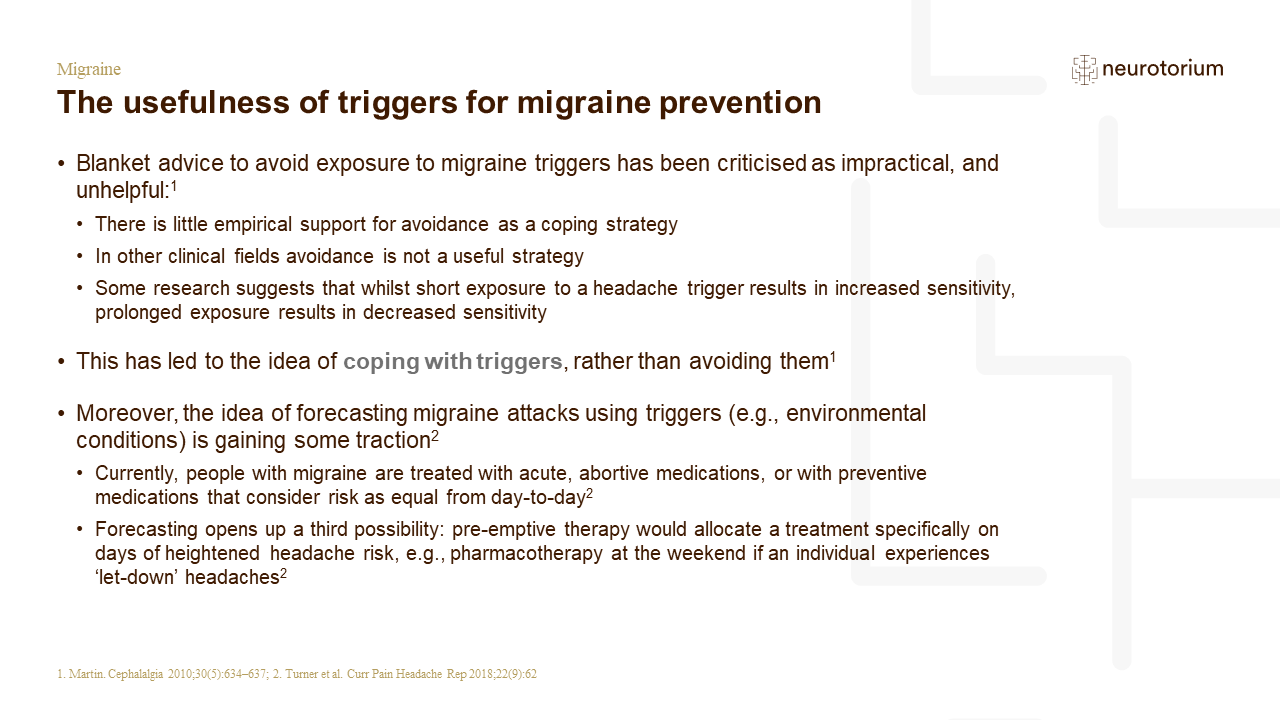
Dealing with trigger factors for migraine requires an element of common sense.[Hoffmann & Recober, 2013] Avoidance of specific avoidable trigger factors may make sense for an individual – e.g., if red wine has been identified by that person as a reliable trigger.[Hoffmann & Recober, 2013] However, avoidance may be associated with a reduction in quality of life, and potentially increased stress which is itself a risk factor for migraine.[Hoffmann & Recober, 2013] Total avoidance of some migraine triggers may also further sensitise an individual to that factor, e.g., people who overuse sunglasses.[Hoffmann & Recober, 2013] This has led to the argument that migraine triggers should be managed, i.e., something to be coped with, rather than avoided.[Martin, 2010]
Other reference used on slide:
Turner DP, Lebowitz AD, Chtay I, Houle TT. Forecasting migraine attacks and the utility of identifying triggers. Curr Pain Headache Rep 2018; 22 (9): 62.