

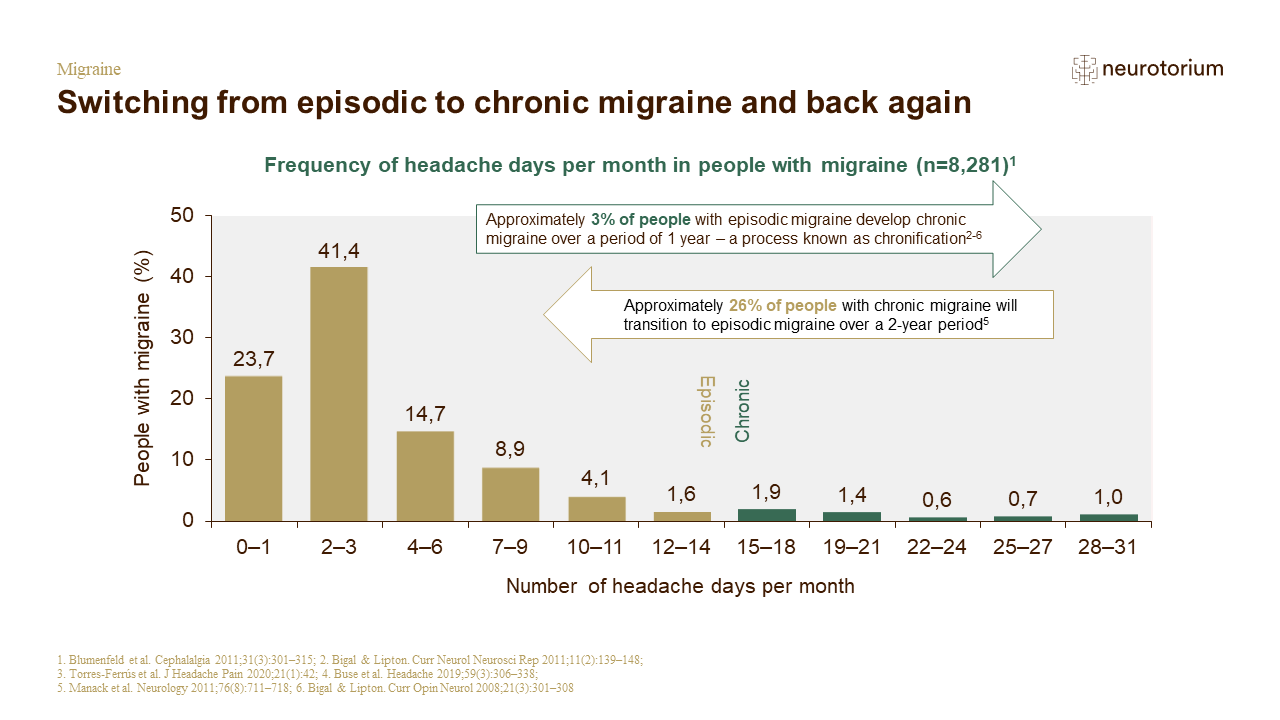
In this study, shown in the graph on the slide, participants were asked to complete a web-based survey.[Blumenfeld et al., 2011] Of the 63,001 individuals contacted, 8,726 were eligible and completed the survey.[Blumenfeld et al., 2011] In total, 5.7% of the respondents had chronic migraine, whilst 94.3% had episodic migraine.[Blumenfeld et al., 2011] People with chronic migraine reported significantly greater disability, lower quality of life, higher levels of anxiety, and also higher levels of healthcare resource use than people with episodic migraine.[Blumenfeld et al., 2011]
The survey showed that chronic migraine is associated with a considerable burden on the individual, and on society,[Blumenfeld et al., 2011] which reinforces the importance of preventing progression from episodic to chronic migraine.
Other references used on slide:
Bigal ME, Lipton RB. The prognosis of migraine. Curr Opin Neurol 2008; 21 (3): 301–308.
Bigal ME, Lipton RB. Migraine chronification. Curr Neurol Neurosci Rep 2011; 11 (2): 139–148.