

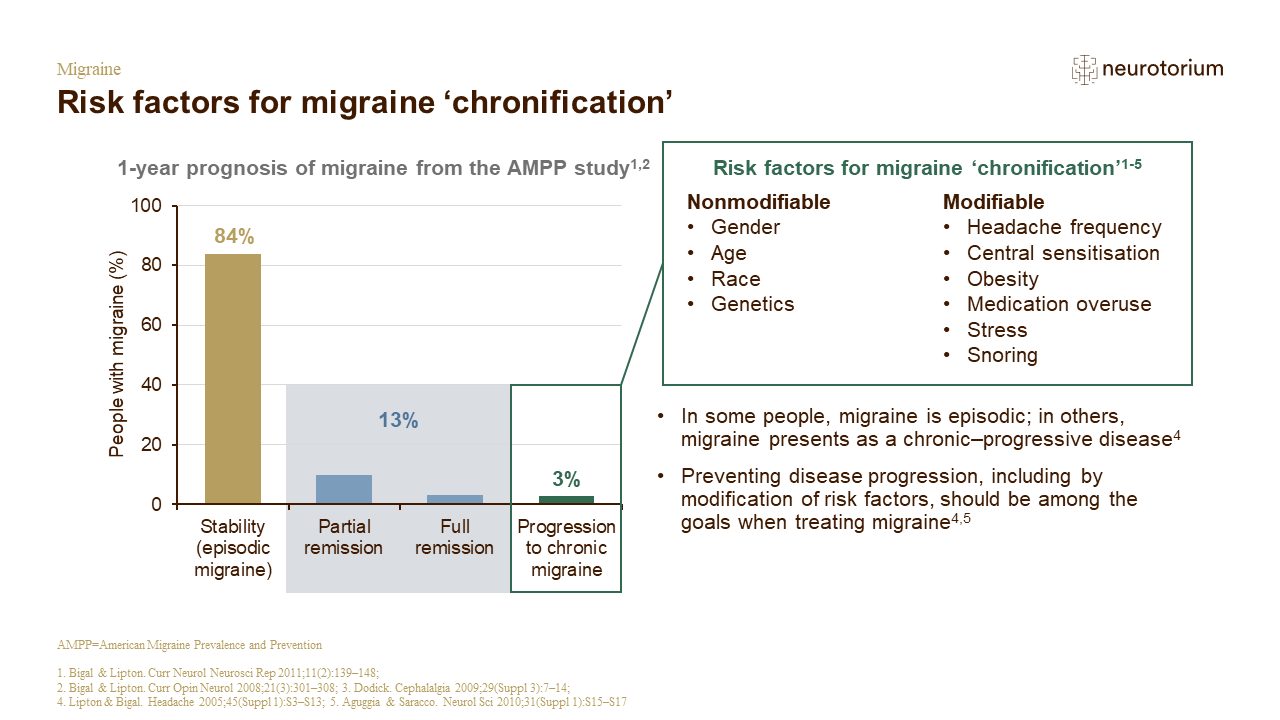
In a subgroup of patients, migraine appears to be a progressive disease – identification of risk factors for progression is therefore clinically important, particularly modifiable risk factors.[Lipton & Bigal, 2005] Given the clinical importance of preventing disease progression, strategies can be devised to target the modifiable risk factors that an individual might exhibit, e.g., if a person with migraine is overweight they could attempt weight loss, or if they have a high-stress life they might benefit from relaxation techniques or biofeedback therapy.[Lipton & Bigal, 2005]
Other references used on slide:
Aguggia M, Saracco MG. Pathophysiology of migraine chronification. Neurol Sci 2010; 31 (Suppl 1): S15–S17.
Bigal ME, Lipton RB. The prognosis of migraine. Curr Opin Neurol 2008; 21 (3): 301–308.
Bigal ME, Lipton RB. Migraine chronification. Curr Neurol Neurosci Rep 2011; 11 (2): 139–148.