

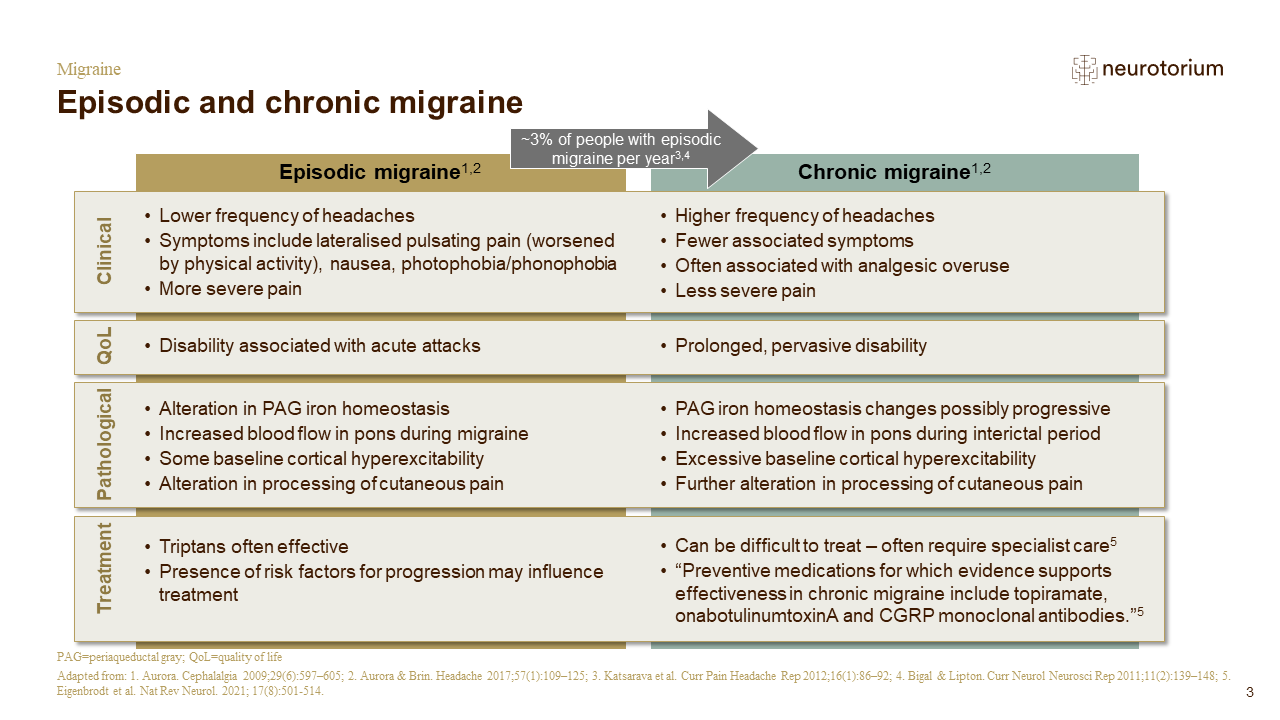
Migraine is a complex spectrum disorder, the clinical and pathological features of which may evolve over time – neuroimaging studies of people with migraine suggest that chronic migraine is associated with progressive brain dysfunction.[Aurora & Brin, 2017] The differences between people with episodic migraine and people with chronic migraine highlights the need for treatments to be tailored to each group.[Aurora, 2009; Aurora & Brin, 2017] It is tempting to consider that effective preventive treatment in patients with chronic migraine might mitigate the effects that chronification may have on the brain.[Aurora & Brin, 2017]
Bigal ME, Lipton RB. Migraine chronification. Curr Neurol Neurosci Rep 2011; 11 (2): 139–148.