

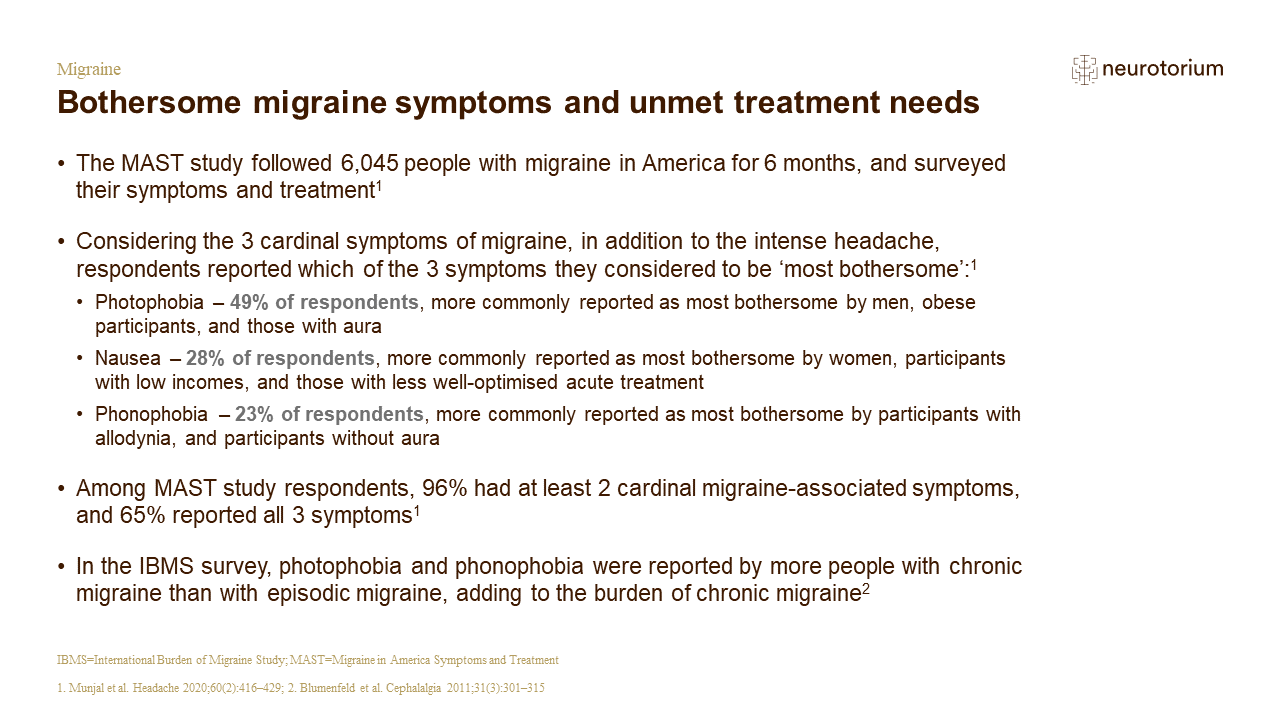
In the Migraine in America Symptoms and Treatment (MAST) study, all 15,133 participants were invited to participate in a 6-month follow-up study.[Munjal et al., 2020] In total, 50% (7,518/15,133) completed the 6-month follow-up study, of whom 80.4% (6,045/7518) continued to meet the criteria for migraine.[Munjal et al., 2020] In identifying the most bothersome symptoms reported by different groups of people with migraine, the authors hope that the most bothersome symptom can be better identified and treated in the future.[Munjal et al., 2020]
In the International Burden of Migraine Study (IBMS), participants were asked to complete a web-based survey.[Blumenfeld et al., 2011] Of the 63,001 individuals contacted, 8,726 were eligible and completed the survey.[Blumenfeld et al., 2011] In total, 5.7% of the respondents had chronic migraine, and 94.3% had episodic migraine.[Blumenfeld et al., 2011] People with chronic migraine reported significantly greater disability, lower quality of life, higher levels of anxiety, and higher levels of healthcare resource use than people with episodic migraine.[Blumenfeld et al., 2011] The survey showed that, compared with episodic migraine, chronic migraine is associated with a greater burden on the patient and on society, [Blumenfeld et al., 2011] which reinforces the importance of preventing progression from episodic to chronic migraine.