

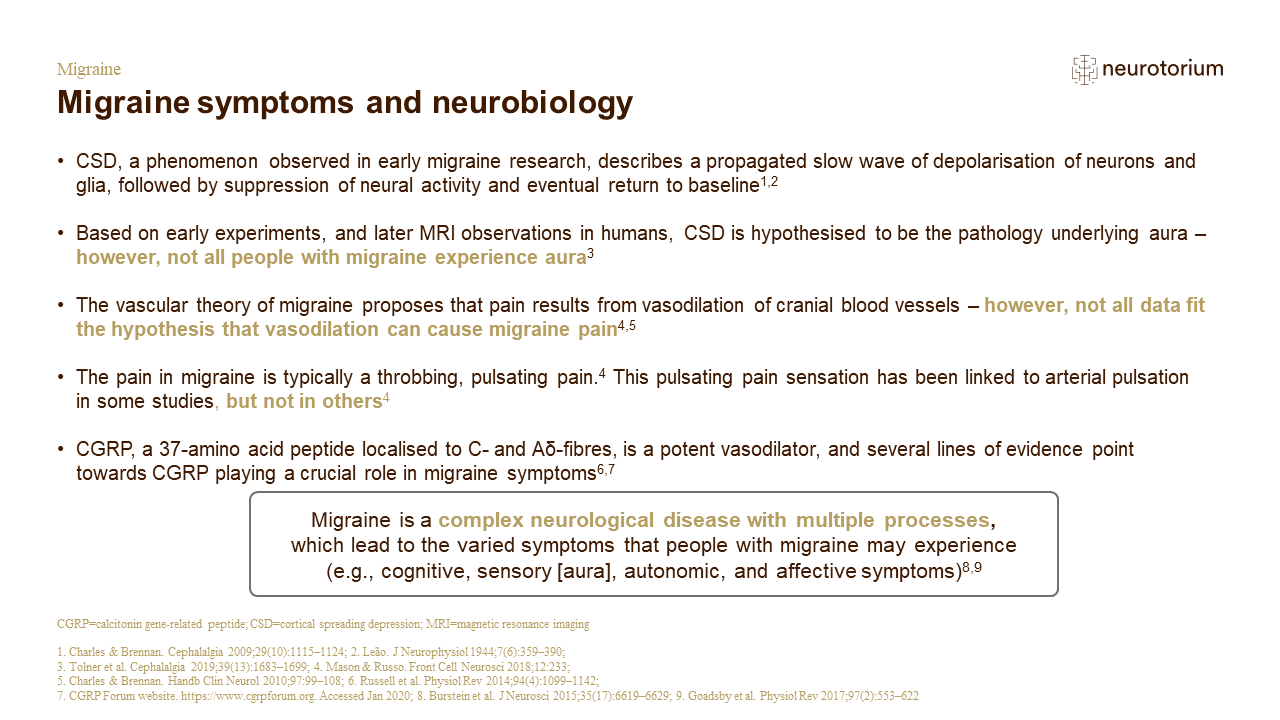
Critics of cortical spreading depression (CSD) have long pointed out that, although observed in animal studies, CSD has not been consistently observed using electroencephalograms (EEG) in humans with migraine.[Charles & Brennan, 2010] Furthermore, CSD would be expected to have quite profound effects on cognitive functioning – effects that are not universally observed in migraine.[Charles & Brennan, 2010] One of the first therapies for migraine – an ergot alkaloid – works by vasoconstriction; this led to attempts to unravel the pathology of migraine by focussing on the vasculature.[Mason & Russo, 2018] However, although vascular changes do occur during a migraine, it is not yet clear to what extent these changes cause, or are a result of, the migraine pathology and the resulting pain.[Mason & Russo, 2018]
References:
Charles A, Brennan KC. The neurobiology of migraine. Handb Clin Neurol 2010; 97: 99–108.
Other references used on slide:
Burstein R, Noseda R, Borsook D. Migraine: multiple processes, complex pathophysiology. J Neurosci 2015; 35 (17): 6619–6629.
CGRP Forum website. https://www.cgrpforum.org. Accessed January 2020.