

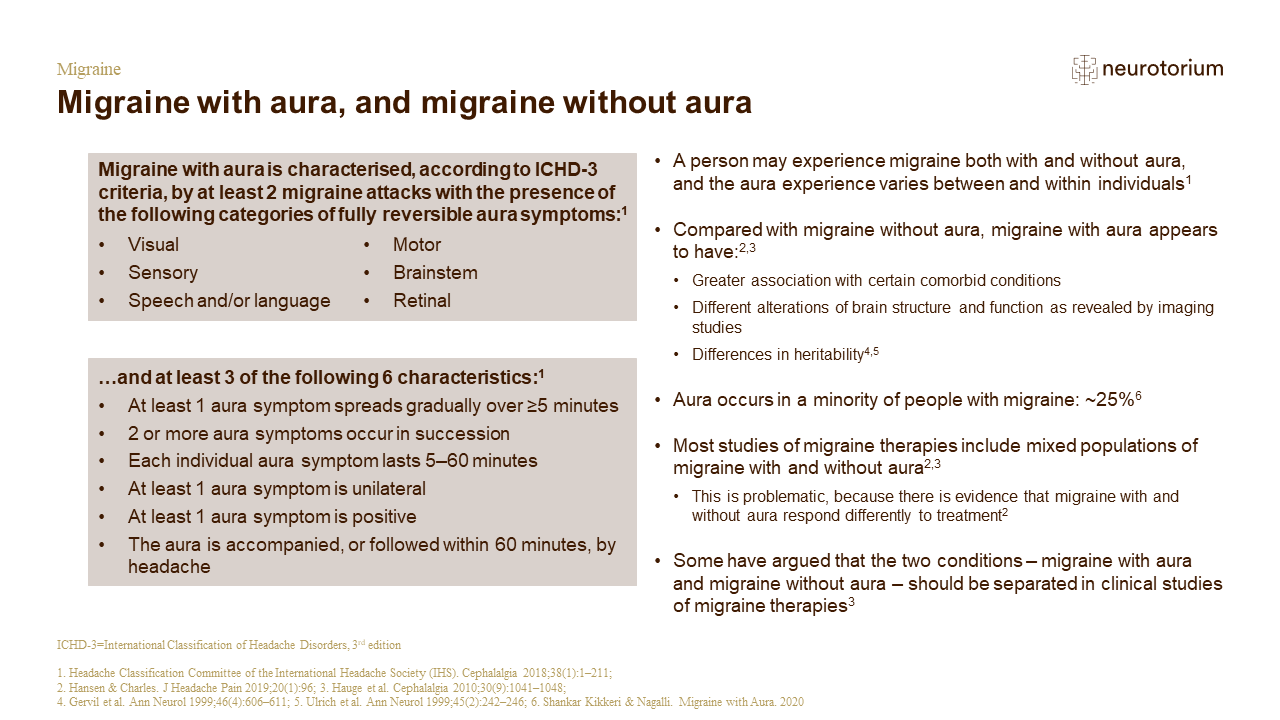
There are important differences between migraine with aura and without aura, as outlined on the slide. However – perhaps because of the lack of clinical studies stratified based on the presence of aura symptoms – it is not clear whether migraine with aura and without aura ought to be treated differently.[Hansen & Charles, 2019] More research is needed, specifically studies with clear distinctions between people with and without aura, to understand how the presence of aura symptoms should influence treatment options.[Hansen & Charles, 2019]
Other references used on slide:
Gervil M, Ulrich V, Kyvik KO, et al. Migraine without aura: a population-based twin study. Ann Neurol 1999; 46 (4): 606–611.
Shankar Kikkeri N, Nagalli S. Migraine with Aura. In: StatPearls [Internet]. Treasure Island (FL): StatPearls Publishing, 2020. Available at: https://www.ncbi.nlm.nih.gov/books/NBK554611/. Accessed January 2020.