

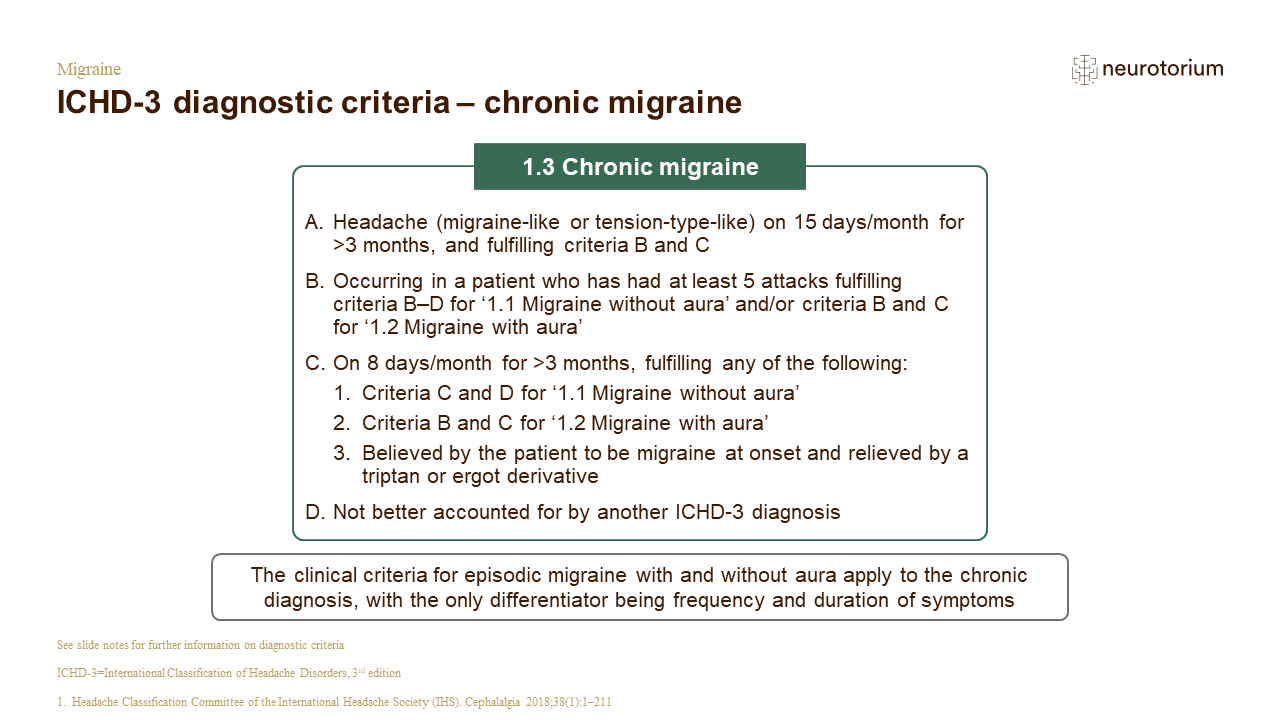
1.3 Chronic migraine[IHS, 2018]
A. Headache (migraine-like or tension-type-likea) on 15 days/month for >3 months, and fulfilling criteria B and C.
B. Occurring in a patient who has had at least five attacks fulfilling criteria B–D for ‘1.1 Migraine without aura’ and/or criteria B and C for ‘1.2 Migraine with aura’.
C. On 8 days/month for >3 months, fulfilling any of the following:b
- criteria C and D for ‘1.1 Migraine without aura’
- criteria B and C for ‘1.2 Migraine with aura’
- believed by the patient to be migraine at onset and relieved by a triptan or ergot derivative.
D. Not better accounted for by another ICHD-3 diagnosis.c-e
aThe reason for singling out ‘1.3 Chronic migraine’ from types of episodic migraine is that it is impossible to distinguish the individual episodes of headache in patients with such frequent or continuous headaches. In fact, the characteristics of the headache may change not only from day to day but even within the same day. Such patients are extremely difficult to keep medication-free in order to observe the natural history of the headache. In this situation, attacks with and without aura are both counted, as are both migraine-like and tension-type-like headaches (but not secondary headaches).
bCharacterisation of frequently recurring headache generally requires a headache diary to record information on pain and associated symptoms day by day for at least one month.
cBecause tension-type-like headache is within the diagnostic criteria for ‘1.3 Chronic migraine’, this diagnosis excludes the diagnosis of ‘2. Tension-type headache’ or its types.
d4.10 New daily persistent headache may have features suggestive of ‘1.3 Chronic migraine’. The latter disorder evolves over time from ‘1.1 Migraine without aura’ and/ or ‘1.2 Migraine with aura’; therefore, when these criteria A–C are fulfilled by headache that, unambiguously, is daily and unremitting from <24 hours after its first onset, code as ‘4.10 New daily persistent headache’. When the manner of onset is not remembered or is otherwise uncertain, code as ‘1.3 Chronic migraine’.
eThe most common cause of symptoms suggestive of chronic migraine is medication overuse, as defined under ‘8.2 Medication-overuse headache’. Around 50% of patients apparently with ‘1.3 Chronic migraine’ revert to an episodic migraine type after drug withdrawal; such patients are in a sense wrongly diagnosed as ‘1.3 Chronic migraine’. Equally, many patients apparently overusing medication do not improve after drug withdrawal; the diagnosis of ‘8.2 Medication-overuse headache’ may be inappropriate for these patients (assuming that chronicity induced by drug overuse is always reversible). For these reasons, and because of the general rule to apply all relevant diagnoses, patients meeting criteria for ‘1.3 Chronic migraine’ and for ‘8.2 Medication-overuse headache’ should be coded for both. After drug withdrawal, migraine will either revert to an episodic type or remain chronic, and should be re-diagnosed accordingly; in the latter case, the diagnosis of ‘8.2 Medication-overuse headache’ may be rescinded.