

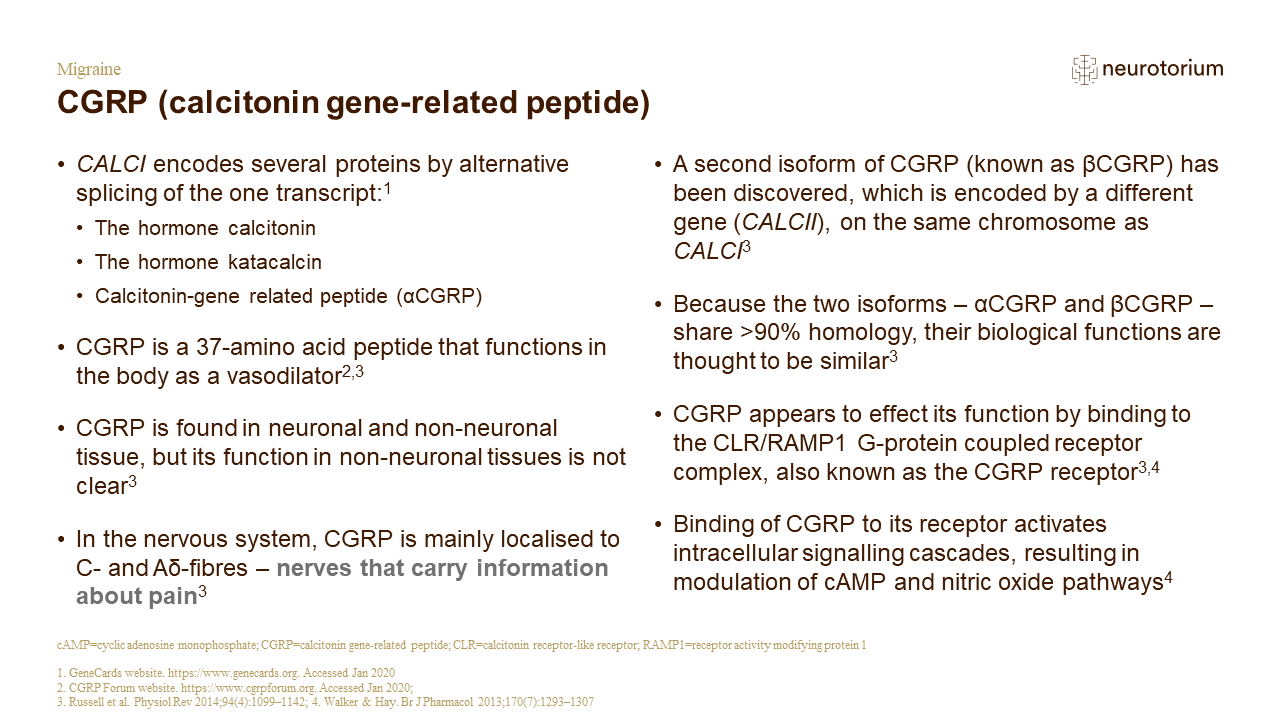
The CALCI gene encodes several different proteins.[Russell et al., 2014] This is achieved by alternative splicing, whereby certain portions of the code are removed from the RNA transcript that is used to produce a protein.[Russell et al., 2014] In the case of CALCI, splicing differs between tissue types – in the thyroid, the fourth exon is included in the final transcript, whereas in the nervous system (the peripheral and central nervous system) the fifth and sixth exons are included but the fourth is not.[Russell et al., 2014] In the thyroid, inclusion of the fourth exon leads to production of the calcitonin protein.[Russell et al., 2014] In the nervous system, inclusion of the fifth and sixth exons leads to production of a 121-amino acid pre-product, that is then cleaved by post-translational processes to produce the mature, 37-amino acid CGRP protein.[Russell et al., 2014] However, the mechanism that controls this alternative splicing process is not entirely clear.[Russell et al., 2014]
Other references used on slide:
CGRP Forum website. https://www.cgrpforum.org. Accessed Jan 2020.
GeneCards website. https://www.genecards.org. Accessed Jan 2020.