

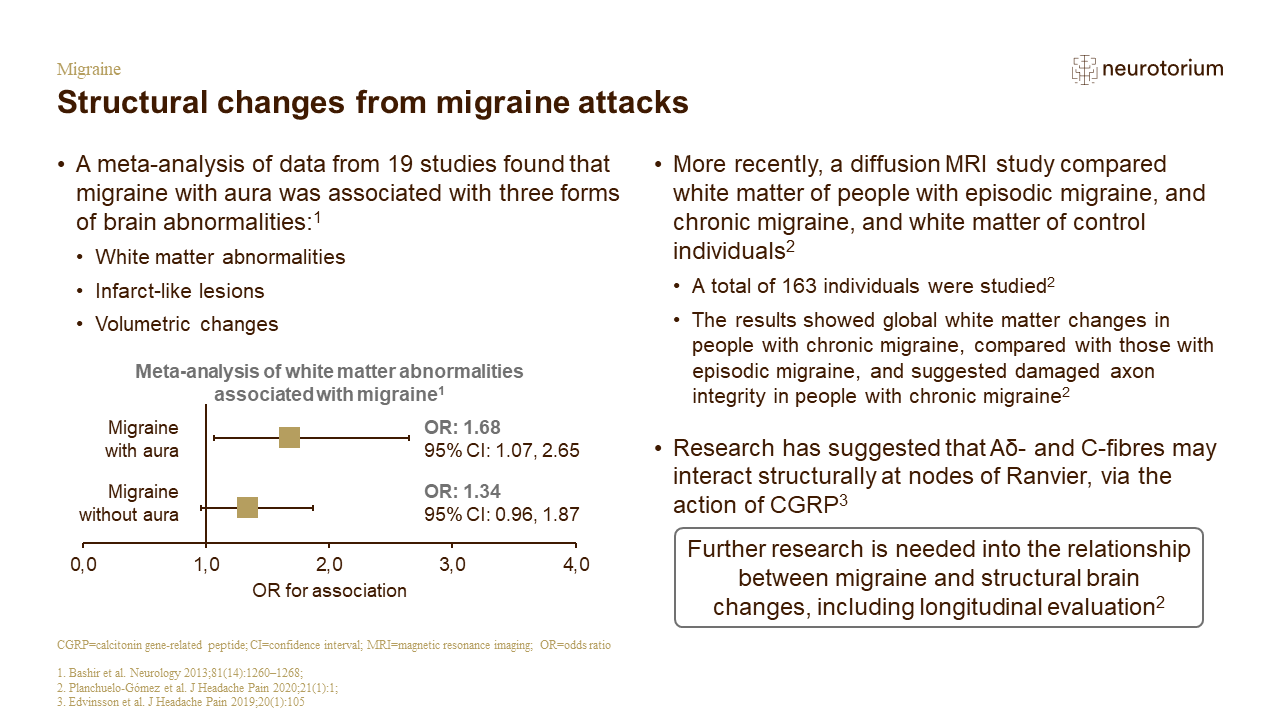
It has been much debated over the years whether or not the recurrent attacks that typify chronic migraine result in damage to the brain.[Bashir et al., 2013; Planchuelo-Gómez et al., 2020] However, with mounting evidence that people with migraine are at an increased risk of clinically silent brain lesions, a meta-analysis attempted to answer this question with specific reference to three types of brain changes: white matter abnormalities, infarct-like lesions, and volumetric changes.[Bashir et al., 2013] The results of the meta-analysis are shown on the slide. From a total of 19 studies, the meta-analysis suggested that people with migraine were at a greater risk of structural brain changes and lesions compared with control individuals.[Bashir et al., 2013] The implications of these results are not clear; whilst more research is needed, one practical application of the result is to consider that people with infarct-like lesions should be evaluated for stroke risk factors.[Bashir et al., 2013]
Other reference used on slide:
Edvinsson JCA, Warfvinge K, Krause DN, et al. C-fibers may modulate adjacent Aδ-fibers through axon-axon CGRP signaling at nodes of Ranvier in the trigeminal system. J Headache Pain 2019; 20 (1): 105.