

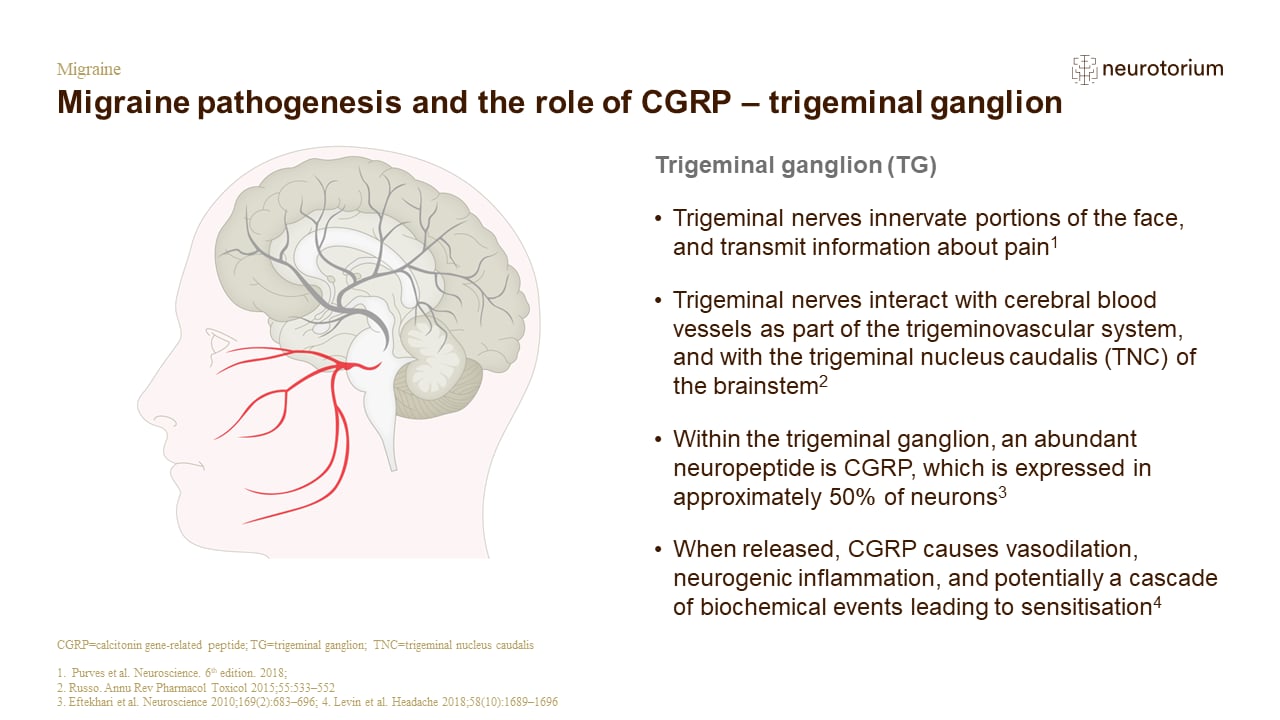
The trigeminal nerve (the fifth cranial nerve), forms three peripheral processes (ophthalmic, maxillary, and mandibular branches, as shown on slide) each of which innervates a portion of the face.[Purves et al., 2018] The central processes of the trigeminal nerve enter the brainstem, and form the ‘trigeminal brainstem complex’.[Purves et al., 2018; Noseda & Burstein, 2013]
Several lines of evidence point to the importance of the trigeminal system in migraine, reviewed in Andreou & Edvinsson, 2019:[Andreou & Edvinsson, 2019]
- The patterns of pain in migraine are similar to patterns of referred pain observed in certain surgeries after stimulation of meningeal and cerebral arteries. These arteries are innervated by trigeminal nerve fibres.
- Experiments suggest that the elevated CGRP found during migraine attacks originates from the trigeminal nerves.
- Agents that cannot cross the blood–brain barrier are capable of causing a migraine attack, and certain effective treatments for migraine cannot cross the blood–brain barrier. Peripheral trigeminal fibres and the trigeminal ganglion are not regions of the brain with a blood–brain barrier.
Purves D, Augustine GJ, Fitzpatrick D, et al. Neuroscience, 6th edition. New York, New York: Oxford University Press, 2018.
Other references used on slide:
Eftekhari S, Salvatore CA, Calamari A, et al. Differential distribution of calcitonin gene-related peptide and its receptor components in the human trigeminal ganglion. Neuroscience 2010; 169 (2): 683–696.