

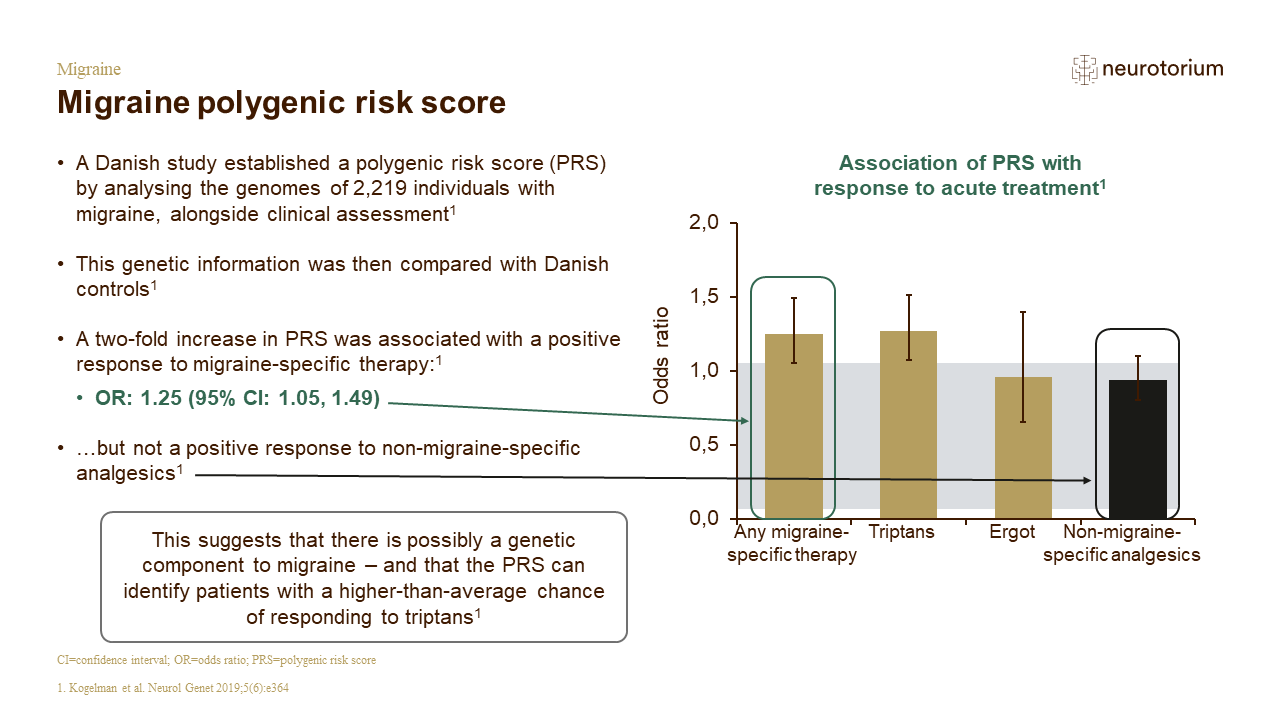
Polygenic risk scores (PRS) attempt to bring together risk contributions from a large number of genes and variations in genetics into a single number that quantifies an individual’s risk for a disease or state.[Vilhjálmsson & Privé, 2019] A Danish study established a PRS for migraine, which was shown to be associated with treatment response (as shown on slide).[Kogelman et al., 2019] Whilst useful, the result has been criticised for several reasons:[Vilhjálmsson & Privé, 2019; Kogelman et al., 2019]
- the treatment effect was quite small (an odds ratio of 1.25)
- although an attempt was made to do so, confounding sources are hard to rule out completely
- the sample was not a random sample.
Furthermore, even if the treatment response is in doubt, some have argued that an individual might as well try a drug and see if it works.[Vilhjálmsson & Privé, 2019] It is important that the scientific value of studies, such as the GWAS outlined on slide, are balanced against the clinical relevance of any findings – genetic screening comes at a cost that might easily outweigh any benefits.[Vilhjálmsson & Privé, 2019]
Vilhjálmsson BJ, Privé F. Headaches and polygenic scores. Neurol Genet 2019; 5 (6): e368.