

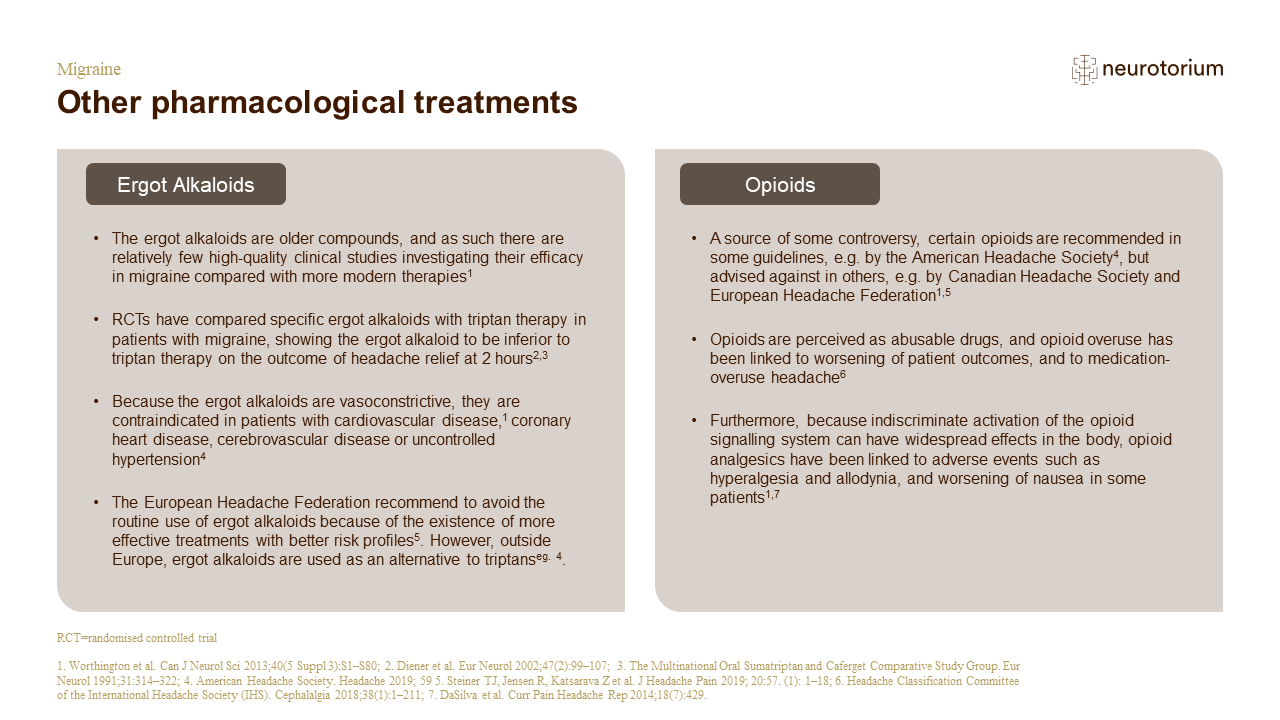
Treatment guidelines rank the evidence supporting individual ergot alkaloids as ranging from strong to relatively poor. Some guidelines recommend the use of ergot alkaloids in treating migraine, albeit weakly.[Marmura et al., 2015; Worthington et al., 2013]
However, many advise to use newer treatments with higher efficacies and better risk profiles [Steiner et al., 2019]. The use of opioids for the treatment of migraine is also not agreed on between different treatment guidelines.[Vargas, 2018] The American Headache Society (AHS) ranks one opioid as having established efficacy, but ranks the remaining opioids as ‘possibly effective’ for the treatment of migraine.[Marmura et al., 2015] However, the Canadian Headache Society guidelines for migraine treatment, as well as the European Headache Federation [Steiner et al. 2019] do not recommend the routine use of opioids in migraine treatment, noting the significant adverse-effect profile associated with opioids, including sedation, dizziness, constipation, tolerance, dependence, and also highlighting their potential for abuse.[Worthington et al., 2013]
Vargas BB. Acute treatment of migraine. Continuum (Minneap Minn) 2018; 24 (4, headache): 1032–1051.
Other references used on slide:
American Headache Society. The American Headache Society position statement on integrating new migraine treatments into clinical practice. Headache 2019; 59 (1): 1–18.
Vargas BB. Acute treatment of migraine. Continuum (Minneap Minn) 2018; 24 (4, headache): 1032–1051.