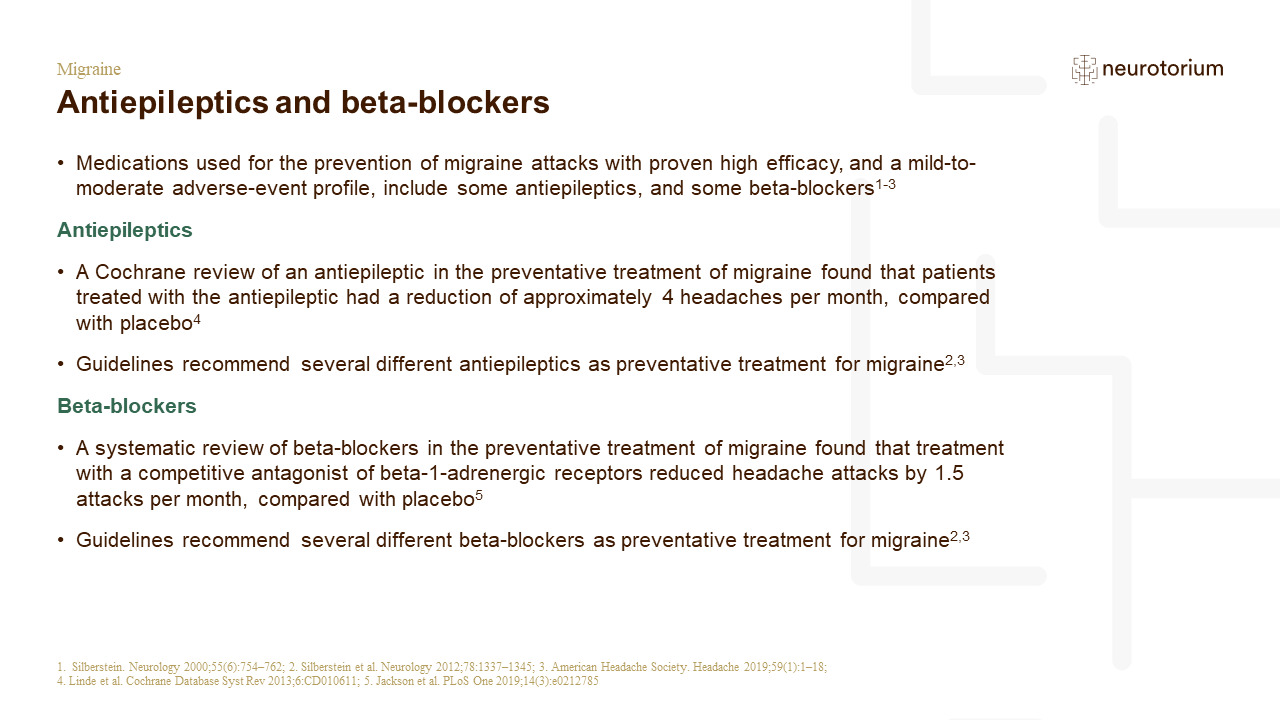
Treatment guidelines rank some antiepileptics as having established efficacy, whilst others are ranked as ‘possibly effective’.[AHS, 2019; Silberstein et al., 2000; Silberstein et al., 2012] Some beta-blockers are ranked as having established efficacy, or as being ‘probably effective’ in migraine prevention.[AHS, 2019; Silberstein et al., 2000; Silberstein et al., 2012]
References:
American Headache Society. The American Headache Society position statement on integrating new migraine treatments into clinical practice. Headache 2019; 59 (1): 1–18.
Silberstein SD. Practice parameter: evidence-based guidelines for migraine headache (an evidence-based review): report of the Quality Standards Subcommittee of the American Academy of Neurology. Neurology 2000; 55 (6): 754–762.
Silberstein SD, Holland S, Freitag F, et al. Evidence‐based guideline update: pharmacologic treatment for episodic migraine prevention in adults: report of the Quality Standards Subcommittee of the American Academy of Neurology and the American Headache Society. Neurology 2012; 78 (17): 1337–1345.
Other references used on slide:
Jackson JL, Kuriyama A, Kuwatsuka Y, et al. Beta-blockers for the prevention of headache in adults, a systematic review and meta-analysis. PLoS One 2019; 14 (3): e0212785.
Linde M, Mulleners WM, Chronicle EP, McCrory DC. Valproate (valproic acid or sodium valproate or a combination of the two) for the prophylaxis of episodic migraine in adults. Cochrane Database Syst Rev 2013; 6: CD010611.