

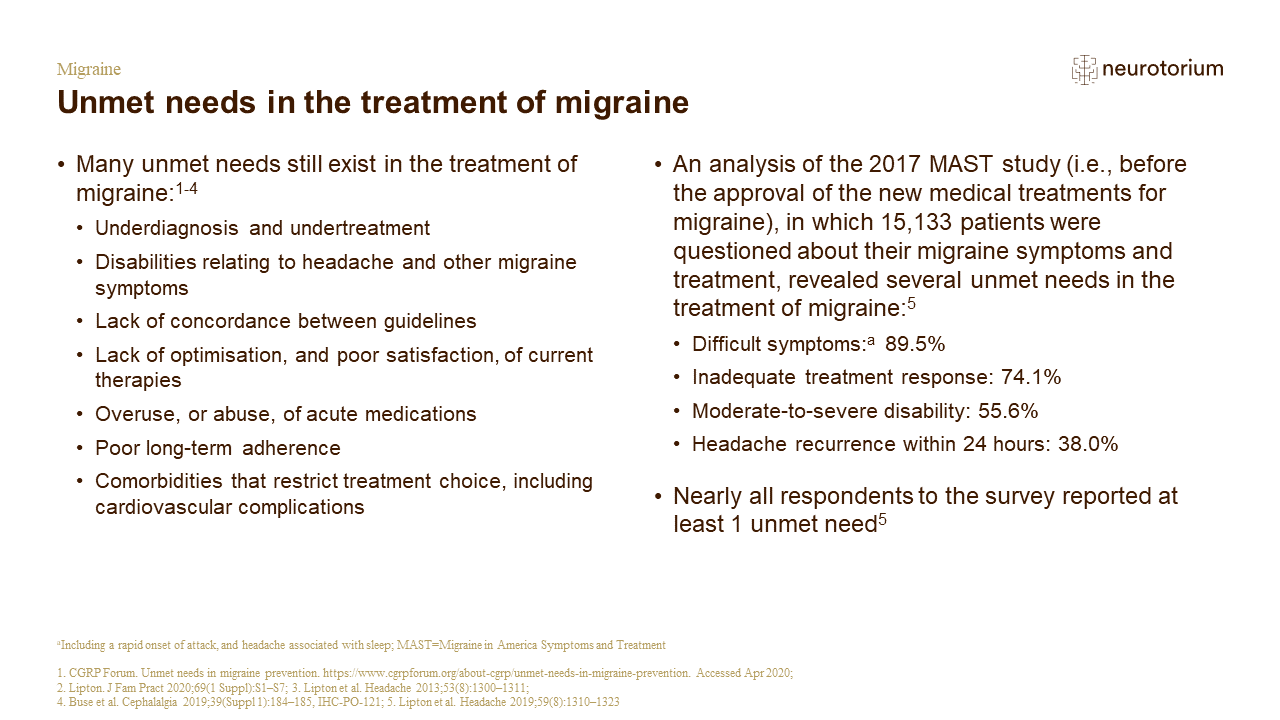
The 2017 MAST study was an online survey of adults meeting the International Classification of Headache Disorders (ICHD) version 3 beta criteria for migraine.[Lipton et al., 2019] Out of 15,133 individuals to respond, 3,930 reported currently using acute migraine medication, and were therefore included in the analysis outlined on the slide.[Lipton et al., 2019] Unmet needs were characterised among respondents, showing that the majority of patients – 95.8% (3,765/3,930) – had at least one unmet need.[Lipton et al., 2019] Perhaps unsurprisingly, an increasing number of unmet treatment need domains was associated with worse psychological symptoms, attack-related cutaneous allodynia, and increased migraine symptom severity.[Lipton et al., 2019]
Other references used on slide:
Buse DC, Nahas SJ, Schwedt TJ, et al. Unmet treatment needs of people with migraine: results of the CaMEO study. Cephalalgia 2019; 39 (Suppl 1): 184–185, IHC-PO-121.
CGRP Forum. Unmet needs in migraine prevention. https://www.cgrpforum.org/about-cgrp/unmet-needs-in-migraine-prevention. Accessed April 2020.