

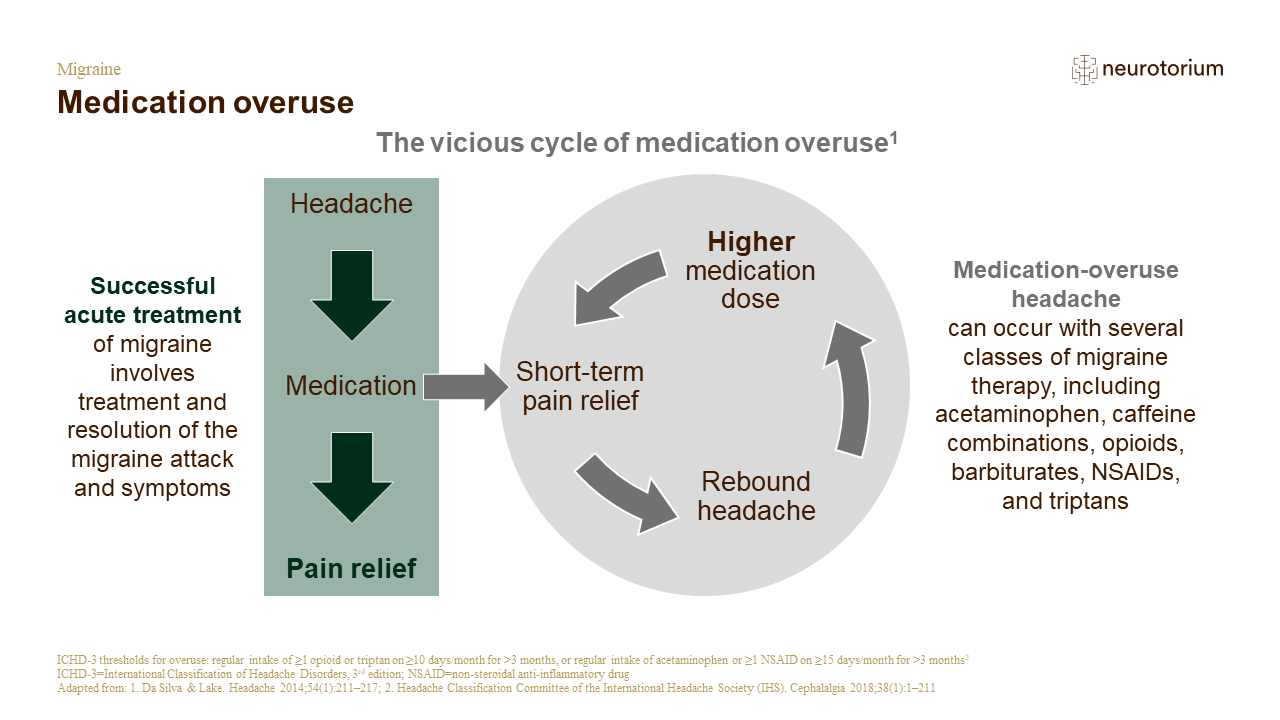
Although not fully understood, the use of certain medications in certain individuals is thought to lead to structural and/or functional brain changes, altering their susceptibility to headaches and migraine.[Chong, 2020; Da Silva & Lake, 2014; Kocasoy Orhan, 2019] Over time, for a variety of reasons, a person with migraine may experience a greater frequency of migraine attacks, leading to a greater use of relief medication.[Da Silva & Lake, 2014] The greater use of medication can become an overuse of medication, and an associated refractoriness; in clinical practice, a common scenario involves transformation of episodic migraine to chronic migraine whilst the patient is overusing one or more migraine therapies.[Da Silva & Lake, 2014] Medication-overuse headache is a subtype of migraine, and compared with episodic migraine is associated with greater use of healthcare resources, and poorer quality of life outcomes.[Da Silva & Lake, 2014]
Other reference used on slide:
Headache Classification Committee of the International Headache Society (IHS). The International Classification of Headache Disorders, 3rd edition. Cephalalgia 2018; 38 (1): 1–211.