

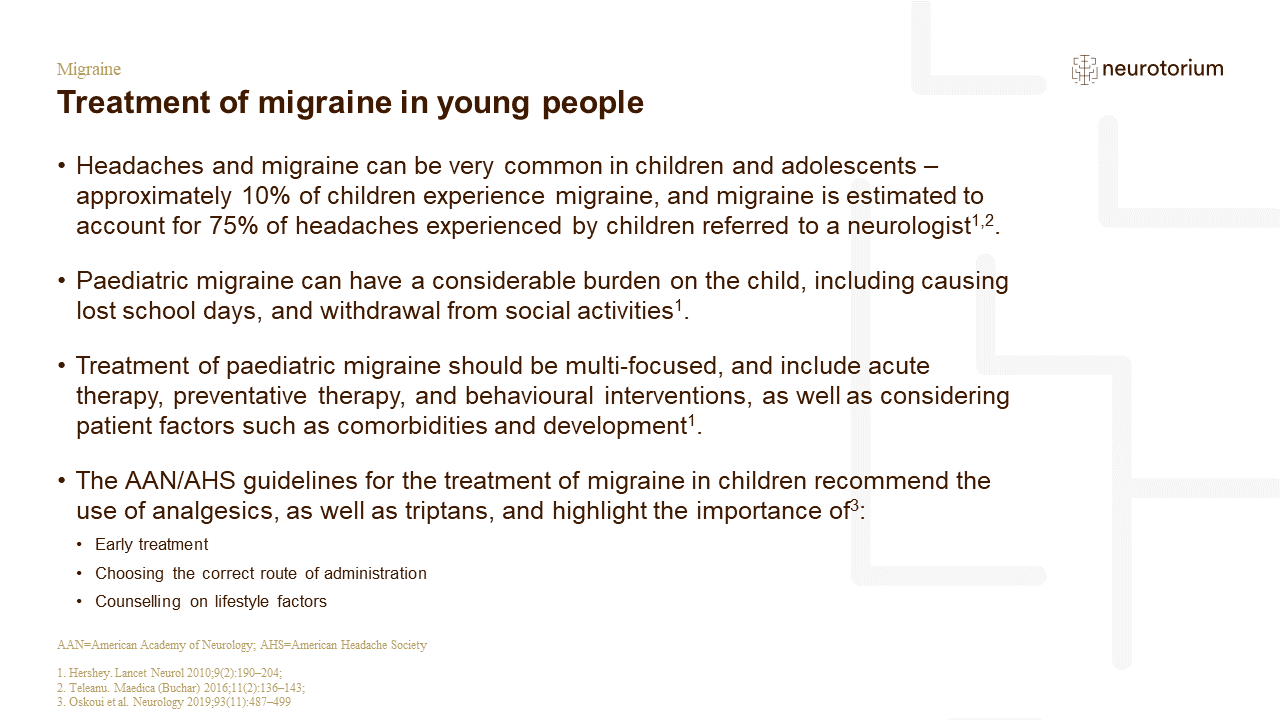
Migraine in children is a common and disabling disease.[Hershey, 2010; Teleanu, 2016] The prevalence of migraine is thought to increase throughout childhood, and peak post-puberty – perhaps accounted for by menstrual migraine in girls.[Teleanu, 2016] Only a minority of children with migraine (roughly a quarter) will be migraine-free by the age of 25.[Teleanu, 2016] In very young children, migraine can be hard to detect and diagnose, with manifestations including episodes of head-banging, vomiting, or wanting to sleep in a dark room.[Teleanu, 2016] As with the adult population, migraine in children is underdiagnosed,[Teleanu, 2016] and therefore undertreated, even though there are treatment guidelines from the American Academy of Neurology and the American Headache Society specific for paediatric migraine.[Oskoui et al., 2019]
Teleanu RI. Treatment of pediatric migraine: a review. Maedica (Buchar) 2016; 11 (2): 136–143.