

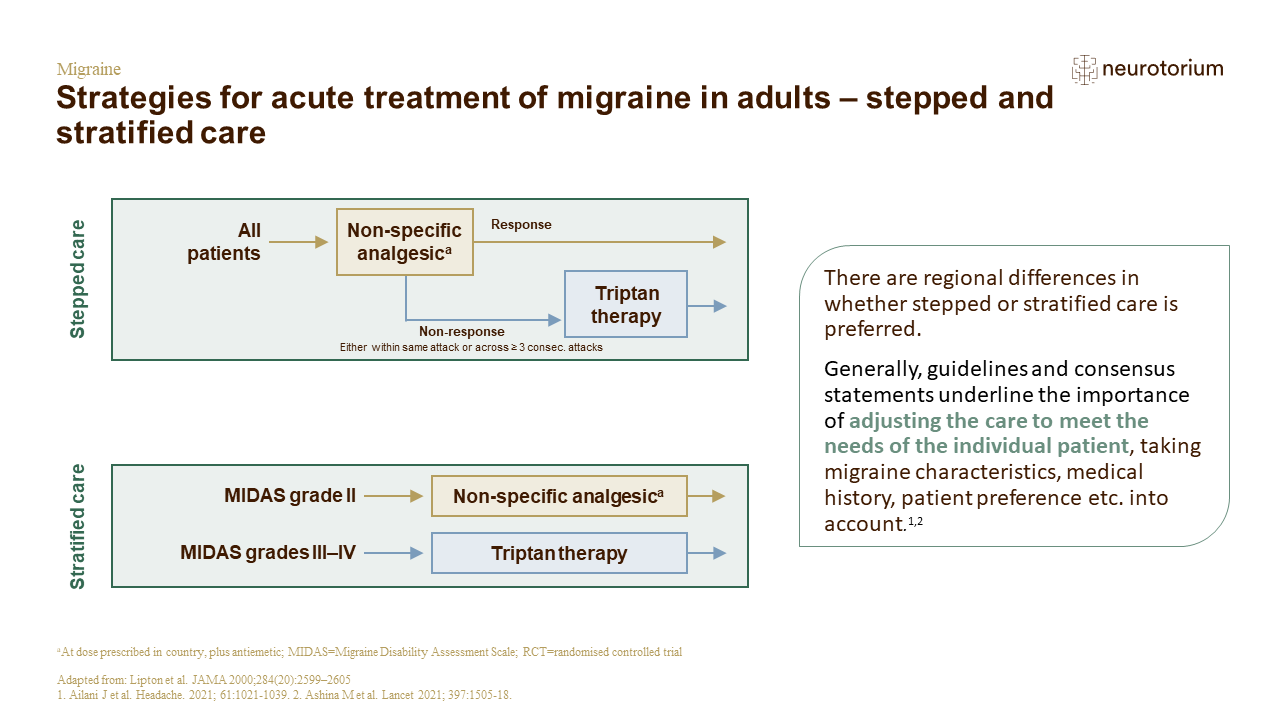
In stepped care: [Lipton et al., 2000]
• Acute treatment starts with simple analgesics.
• If there’s insufficient or no response, the patient is offered migraine specific treatment.
Stepped care can be applied within or across attacks.[Ashina et al., 2021; Lipton et al., 2000] Within attack, migraine specific treatment is offered if response is not sufficient within typically 2 hours[Lipton et al., 2000]. Across attacks, migraine specific treatment if offered if response is not sufficient after 3 consecutive attacks.[Steiner et al., 2019] Stepped care is recommended by a recent European consensus statement, [Eigenbrodt et al., 2021] and considered better on an economic and practical level by the European Headache Federation. [Steiner, 2019; Eigenbrodt et al., 2021]
In stratified care: [Lipton et al., 2000]
• Patients’ degree of migraine-related disability is assessed.
• Choice of acute treatment is based on the assessment. Patients with mild disabilities are treated with simple analgesics. Patients with moderate to severe disabilities are treated with migraine specific medication.
A seminal multicentre RCT indicated that stratified care was more efficacious; however, rates of adverse events were greater.[Lipton et al., 2000] The study was conducted across 13 countries, analysed 835 patients with migraine and a MIDAS grade of II-IV, who were treated based on stepped care strategies or a stratified care strategy, and compared the outcomes. The results of the study indicated that stratified care was more efficacious compared with a stepped care model, as measured by headache response and by disability. Rates of adverse events were greater in the stratified care group.
In clinical practice, stepped care has been argued to be more feasible and better on an economic level. [Steiner et al., 2019] Often patients will have tried several non-prescription medications before being referred to a specialist, in effect already having begun a stepped care approach. [Worthington et al., 2019]