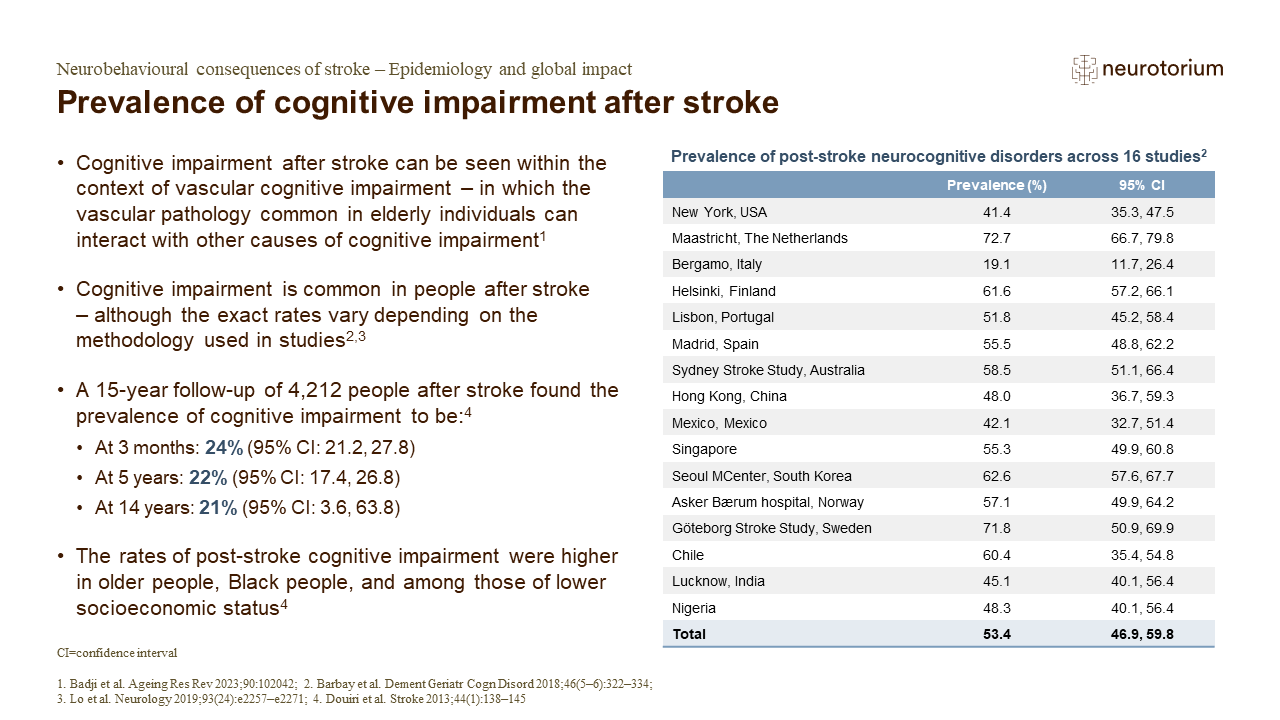
The systematic review and meta-analysis shown on the slide found 16 hospital-based studies of post-stroke neurocognitive disorders, which included a total of 3,087 people with stroke.2 Although prevalence data varied across the studies, as shown on the slide, the overall prevalence of post-stroke neurocognitive disorder was 53.4%.2 Investigating cognitive impairment after stroke is challenging, partly because of the potentially confounding effects of ‘vascular cognitive impairment’ – which describes the deleterious effect on cognitive functioning, ranging from mild to severe, that can be caused by reduced functioning of the vasculature.1 Of course, in the context of a stroke, cognitive impairment from damage to the vasculature of the brain caused by a stroke can be difficult to disentangle from an ongoing pathology of vascular cognitive impairment.1
Prevalence of cognitive impairment after stroke