

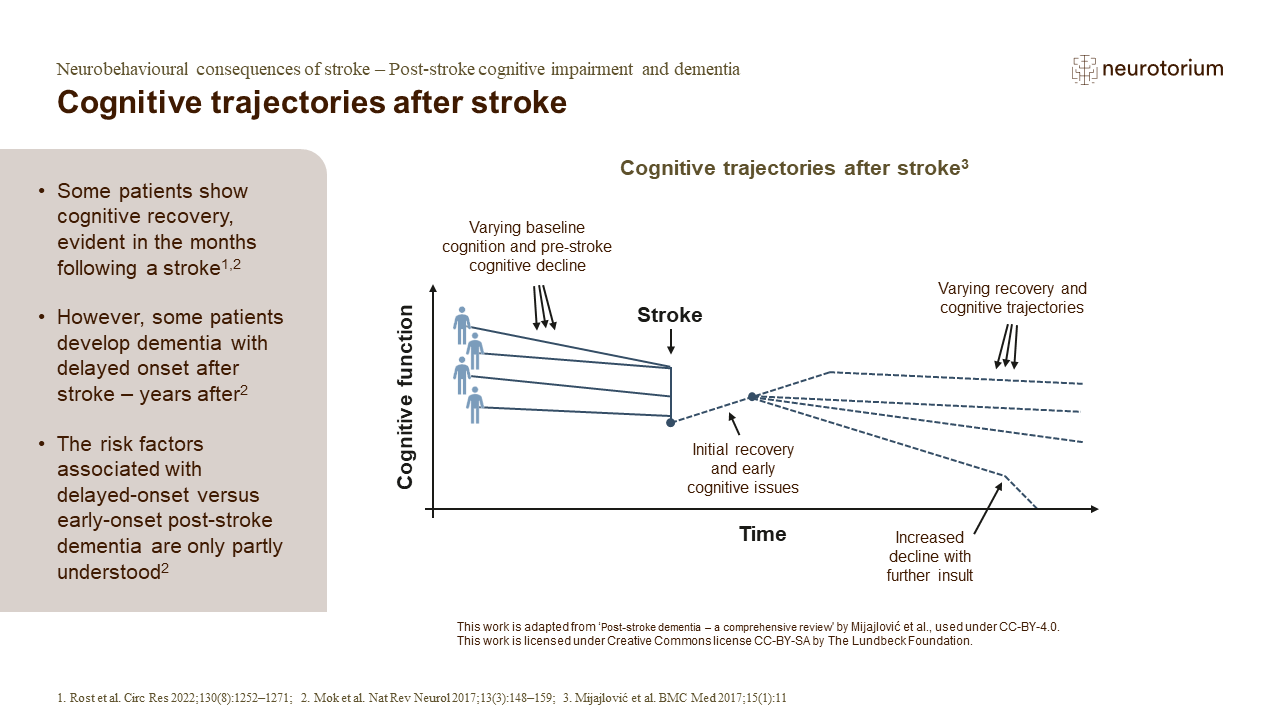
As shown on the slide, there are different paths of recovery that a patient can take after a stroke, which range from some degree of cognitive recovery to a steep decline and recurrent strokes.1,3 Patients can show some early recovery,1-3 but this is reduced in patients with:
- greater small vessel disease burden4
- diabetes mellitus, older age5
- early executive dysfunction.6
References:
1. Rost NS, Brodtmann A, Pase MP, et al. Post-stroke cognitive impairment and dementia. Circ Res 2022; 130 (8): 1252–1271.
2. Mok VCT, Lam BYK, Wong A, et al. Early-onset and delayed-onset poststroke dementia – revisiting the mechanisms. Nat Rev Neurol 2017; 13 (3): 148–159.
3. Mijajlović MD, Pavlović A, Brainin M, et al. Post-stroke dementia – a comprehensive review. BMC Med 2017; 15 (1): 11.
4. Sagnier S, Catheline G, Munsch F, et al. Severity of small vessel disease biomarkers reduces the magnitude of cognitive recovery after ischemic stroke. Cerebrovasc Dis 2021; 50 (4): 456–463.
5. Nys GMS, van Zandvoort MJE, De Kort PLM, et al. Domain-specific cognitive recovery after first-ever stroke: a follow-up study of 111 cases. J Int Neuropsychol Soc 2005; 11 (7): 795–806.
6. Nys GMS, van Zandvoort MJE, de Kort PLM, et al. The prognostic value of domain-specific cognitive abilities in acute first-ever stroke. Neurology 2005; 64 (5): 821–827.