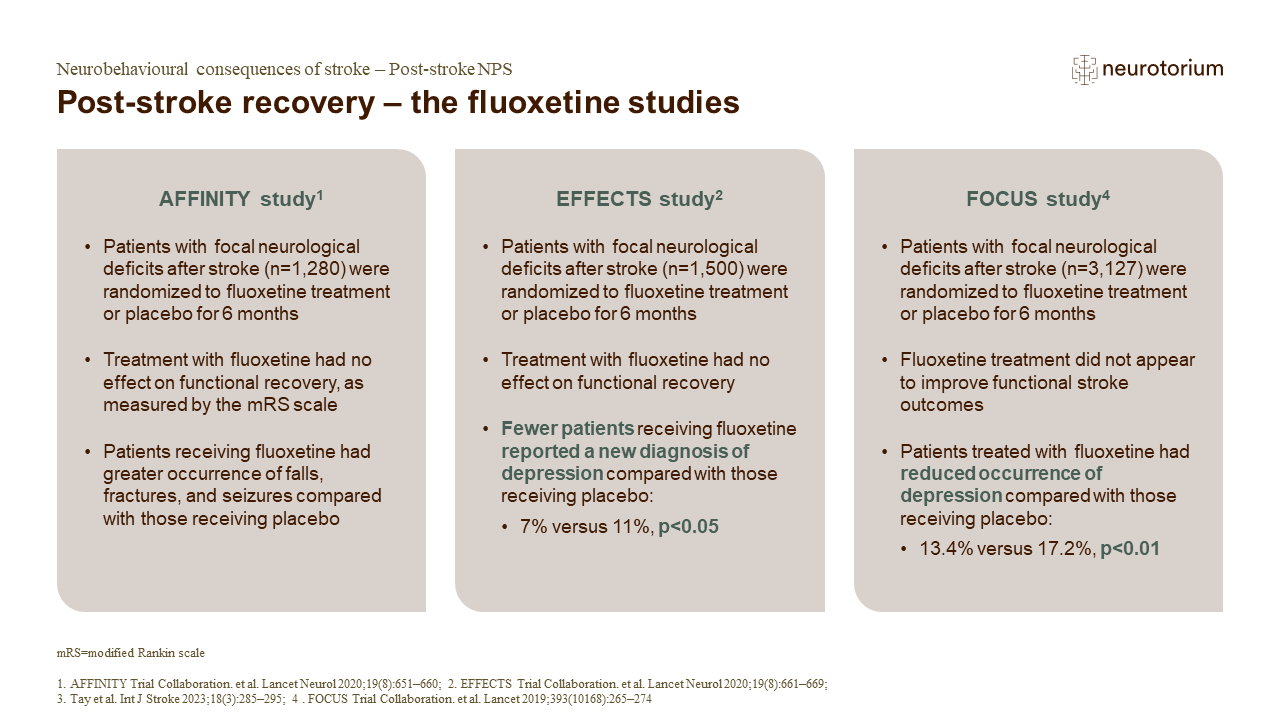
The AFFINITY, EFFECTS, and FOCUS studies were large-scale studies investigating the effects on post-stroke recovery of six months of treatment with fluoxetine.1,2,4 As outlined on the slide, the effects on functional recovery after stroke were negligible.1,2,4 The results of the studies did show small reductions in depressive symptoms in those treated with fluoxetine compared with placebo.1,2,4 In the EFFECTS study, the effect on apathy was reported as a secondary outcome using the individual items from Montgomery–Åsberg Depression Rating Scale (MADRS).2,3 The results suggested that fluoxetine reduced depression but not apathy, suggesting that apathy and depression are different phenomena.2,3
References:
1.AFFINITY Trial Collaboration. Safety and efficacy of fluoxetine on functional outcome after acute stroke (AFFINITY): a randomised, double-blind, placebo-controlled trial. Lancet Neurol 2020; 19 (8): 651–660.
2.EFFECTS Trial Collaboration. Safety and efficacy of fluoxetine on functional recovery after acute stroke (EFFECTS): a randomised, double-blind, placebo-controlled trial. Lancet Neurol 2020; 19 (8): 661–669.
3.Tay J; EFFECTS Trial Collaboration; Mårtensson B, Markus HS, Lundström E. Does fluoxetine reduce apathetic and depressive symptoms after stroke? An analysis of the Efficacy oF Fluoxetine-a randomized Controlled Trial in Stroke trial data set. Int J Stroke 2023; 18 (3): 285–295.
4.FOCUS Trial Collaboration. Effects of fluoxetine on functional outcomes after acute stroke (FOCUS): a pragmatic, double-blind, randomised, controlled trial. Lancet 2019; 393 (10168): 265–274.