

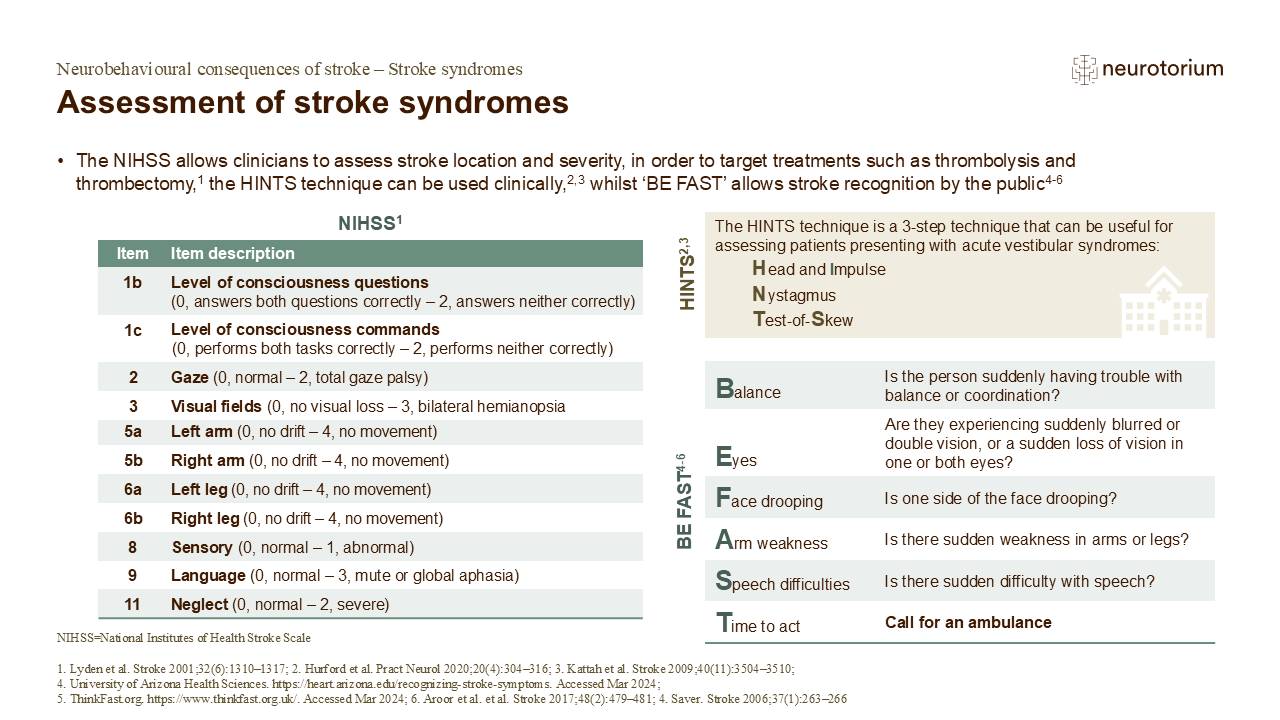
The National Institutes of Health Stroke Scale (NIHSS) was developed in the 1980s and has been widely used and since modified into a more reliable form, the modified NIHSS.1,4,5 The NIHSS is designed to capture the severity of a stroke.1 BE FAST is an acronym developed to help people identify the most common symptoms of stroke – drooping face, arm weakness, and speech difficulties.7,8
References:
1. Brott T, Adams HP Jr, Olinger CP, et al. Measurements of acute cerebral infarction: a clinical examination scale. Stroke 1989; 20 (7): 864–870.
2. Hurford R, Sekhar A, Hughes TAT, Muir KW. Diagnosis and management of acute ischaemic stroke. Pract Neurol 2020; 20 (4): 304–316.
3. Kattah JC, Talkad AV, Wang DZ, et al. HINTS to diagnose stroke in the acute vestibular syndrome: three-step bedside oculomotor examination more sensitive than early MRI diffusion-weighted imaging. Stroke 2009; 40 (11): 3504–3510.
4. Lyden P, Lu M, Jackson C, et al; NINDS tPA Stroke Trial Investigators. Underlying structure of the National Institutes of Health Stroke Scale: results of a factor analysis. Stroke 1999; 30 (11): 2347–2354.
5. Lyden PD, Lu M, Levine SR, et al.; NINDS rtPA Stroke Study Group. A modified National Institutes of Health Stroke Scale for use in stroke clinical trials: preliminary reliability and validity. Stroke 2001; 32 (6): 1310–1317.
6. University of Arizona Health Sciences. https://heart.arizona.edu/recognizing-stroke-symptoms. Accessed March 2024.
7. ThinkFast.org. https://www.thinkfast.org.uk/; Accessed Jul 2023.
8. Aroor S, Singh R, Goldstein LB. BE-FAST (Balance, Eyes, Face, Arm, Speech, Time): reducing the proportion of strokes missed using the FAST mnemonic. Stroke 2017; 48 (2): 479–481.