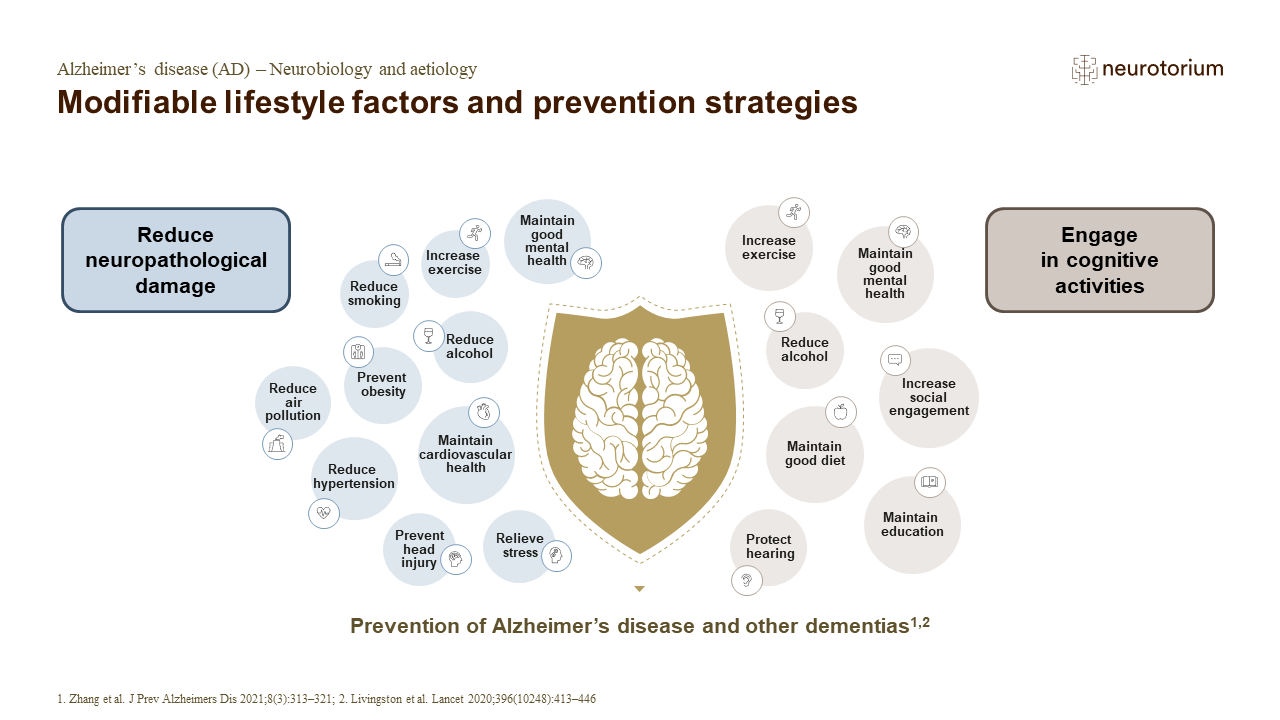
AD has a long prodromal phase, during which early prevention is important to slow progression of the disease.1 Psychosocial factors such as educational attainment and bilingualism work to enhance cognitive activity, processing, and intellectual capacities.1,3 Regular social engagement has also been associated with a reduced risk for dementia, by enhancing the cognitive reserve.4 Additionally, maintaining a healthy body and lifestyle, and reducing environmental exposures are important for reducing neuropathological damage and preventing AD.1
References:
1.Zhang XX, Tian Y, Wang ZT, et al. The epidemiology of Alzheimer’s disease modifiable risk factors and prevention. J Prev Alzheimers Dis 2021; 8 (3): 313–321.
2.Livingston G, Huntley J, Sommerlad A, et al. Dementia prevention, intervention, and care: 2020 report of the Lancet Commission. Lancet 2020; 396 (10248): 413–446.
3.Matyas N, Keser Aschenberger F, Wagner G, et al. Continuing education for the prevention of mild cognitive impairment and Alzheimer’s-type dementia: a systematic review and overview of systematic reviews. BMJ Open 2019; 9 (7): e027719.
4.Sommerlad A, Sabia S, Singh-Manoux A, et al. Association of social contact with dementia and cognition: 28-year follow-up of the Whitehall II cohort study. PLoS Med 2019; 16 (8): e1002862.