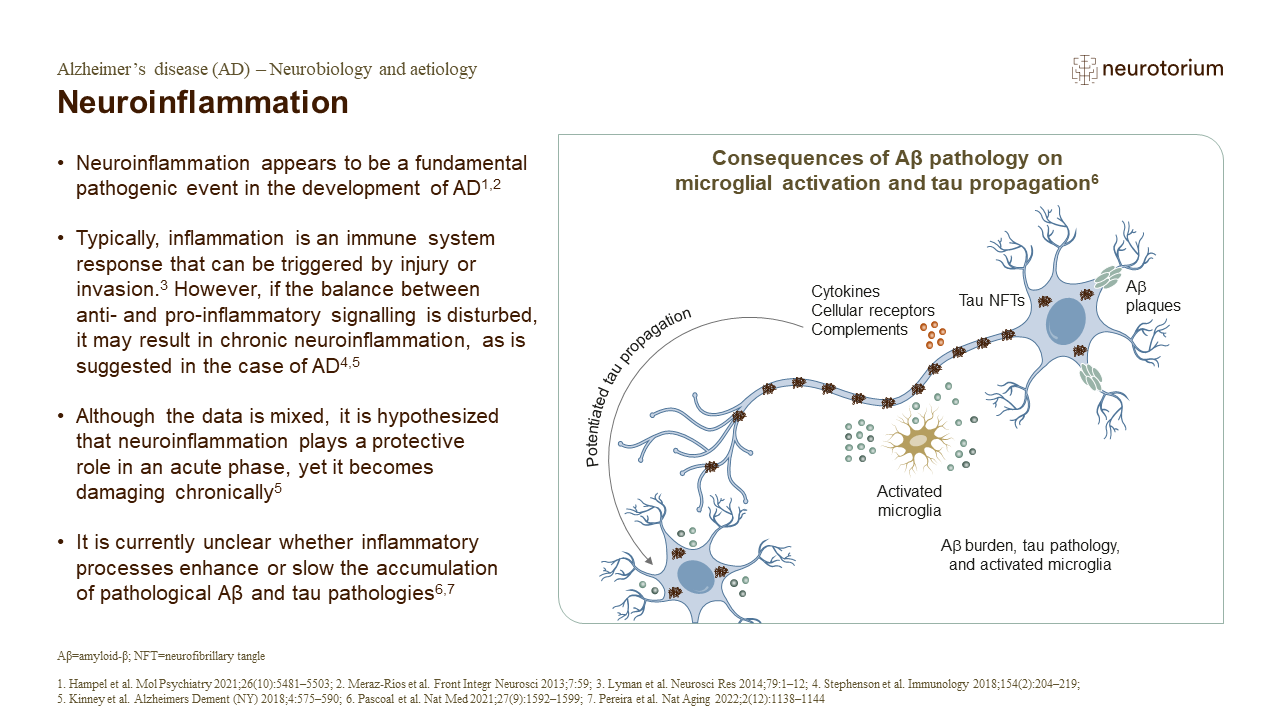
The relationship between two key contributors of neuroinflammation, Aß and glial cells, is a rapidly growing research area. Understanding the relationship of these contributors may allow determination of whether neuroinflammation can trigger and sustain emerging Aß dyshomeostasis, compensate for it, or carry out both in a stage-dependent manner.1 Microglial cells are activated by Aß deposits, which may initially appear as a protective phenotype.8 Continuation of Aß deposition reduces the efficiency of microglial cells, which leads to neuroinflammation.8 The colocalization of Aβ, tau, and activated microglia in the brain potentiates tau propagation.6 This suggests that Aβ and microglial activations are two partially independent processes that converge and lead to neocortical tau pathology.6 The majority of studies that have been carried out in vitro and in murine models of ageing and AD suggest that neuroinflammation is a key characteristic of AD aetiology.1 However, human studies of the mechanisms of neuroinflammation are limited due to the early stage of development, or lack of clinical validation of relevant biomarkers.1
References:
1.Hampel H, Hardy J, Blennow K, et al. The amyloid-β pathway in Alzheimer’s Disease. Mol Psychiatry 2021; 26 (10): 5481–5503.
2.Meraz-Ríos MA, Toral-Rios D, Franco-Bocanegra D, et al. Inflammatory process in Alzheimer’s Disease. Front Integr Neurosci 2013; 7: 59.
3.Lyman M, Lloyd DG, Ji X, Vizcaychipi MP, Ma D. Neuroinflammation: the role and consequences. Neurosci Res 2014; 79: 1–12.
4.Stephenson J, Nutma E, van der Valk P, Amor S. Inflammation in CNS neurodegenerative diseases. Immunology 2018; 154 (2): 204–219.
5.Kinney JW, Bemiller SM, Murtishaw AS, et al. Inflammation as a central mechanism in Alzheimer’s disease. Alzheimers Dement (NY) 2018; 4: 575–590.
6.Pascoal TA, Benedet AL, Ashton NJ, et al. Microglial activation and tau propagate jointly across Braak stages. Nat Med 2021; 27 (9): 1592–1599.
7.Pereira JB, Janelidze S, Strandberg O, et al. Microglial activation protects against accumulation of tau aggregates in nondemented individuals with underlying Alzheimer’s disease pathology. Nat Aging 2022; 2 (12): 1138–1144.
8.Long HZ, Zhou ZW, Cheng Y, et al. The role of microglia in Alzheimer’s disease from the perspective of immune inflammation and iron metabolism. Front Aging Neurosci 2022; 14: 888989.