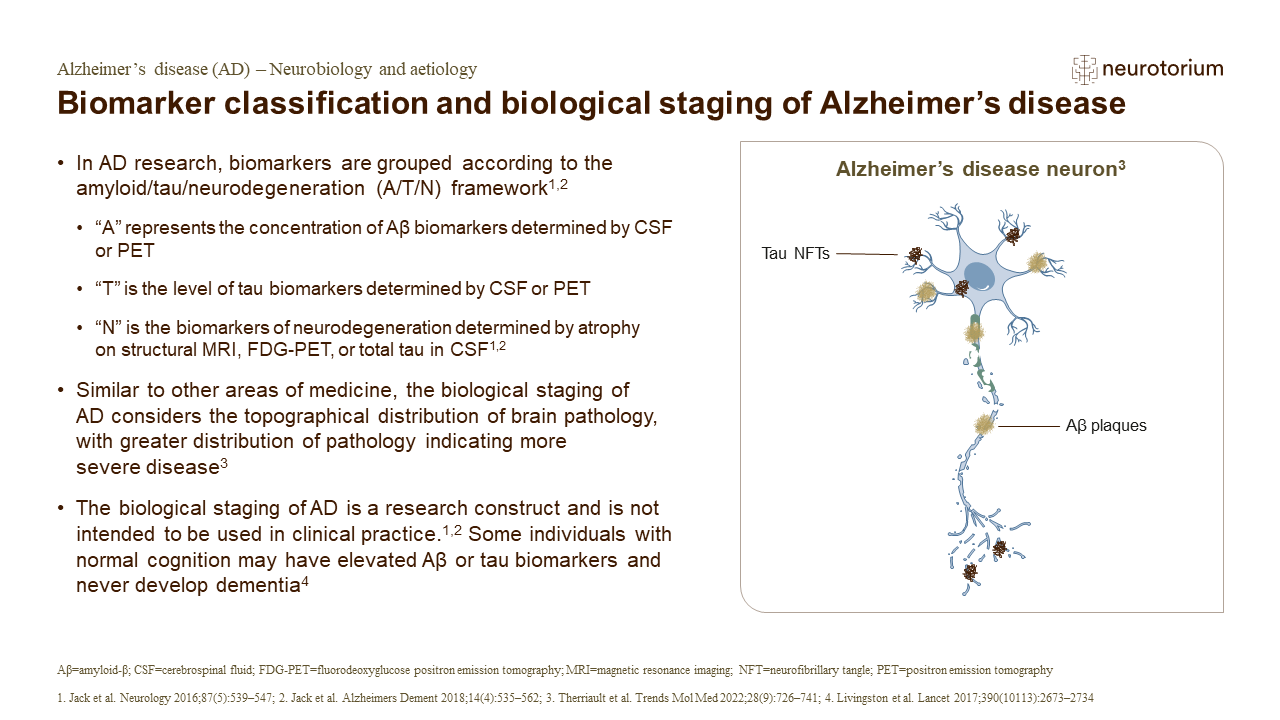
In the A/T/N framework, each biomarker is classified as positive or negative, resulting in individual scores.1 While the key biomarkers described in the A/T/N framework are associated with AD, they are not equally specific.1 Amyloid PET biomarkers bind to Aß deposits in vessel walls, with increased binding observed following acute traumatic brain injury.1,5 In some non-AD conditions such as herpes simplex type 1 (HSV-I) encephalitis, and multiple system atrophy, abnormally decreased CSF Aß42 can be observed.6,7 Atrophy and hypometabolism are the least specific biomarkers for AD and involve AD-like regions in a variety of disorders.1,8 Therefore, understanding biomarker data is convoluted by the common coexistence of positive AD biomarkers with other age-related pathologies.1
References:
1.Jack CR Jr, Bennett DA, Blennow K, et al. A/T/N: An unbiased descriptive classification scheme for Alzheimer disease biomarkers. Neurology 2016; 87 (5): 539–547.
2.Jack CR Jr, Bennett DA, Blennow K, et al. NIA-AA Research Framework: toward a biological definition of Alzheimer’s disease. Alzheimers Dement 2018; 14 (4): 535–562.
3.Therriault J, Zimmer ER, Benedet AL, et al. Staging of Alzheimer’s disease: past, present, and future perspectives. Trends Mol Med 2022; 28 (9): 726–741.
4.Livingston G, Sommerlad A, Orgeta V, et al. Dementia prevention, intervention, and care. Lancet 2017; 390 (10113): 2673–2734.
5.Hong YT, Veenith T, Dewar D, et al. Amyloid imaging with carbon 11-labeled Pittsburgh compound B for traumatic brain injury. JAMA Neurol 2014; 71 (1): 23–31.
6.Krut JJ, Zetterberg H, Blennow K, et al. Cerebrospinal fluid Alzheimer’s biomarker profiles in CNS infections. J Neurol 2013; 260 (2): 620–626.
7.Holmberg B, Johnels B, Blennow K, Rosengren L. Cerebrospinal fluid Ab42 is reduced in multiple system atrophy but normal in Parkinson’s disease and progressive supranuclear palsy. Mov Disord 2003; 18 (2): 186–190.
8.Fotuhi M, Do D, Jack C. Modifiable factors that alter the size of the hippocampus with ageing. Nat Rev Neurol 2012; 8 (4): 189–202.