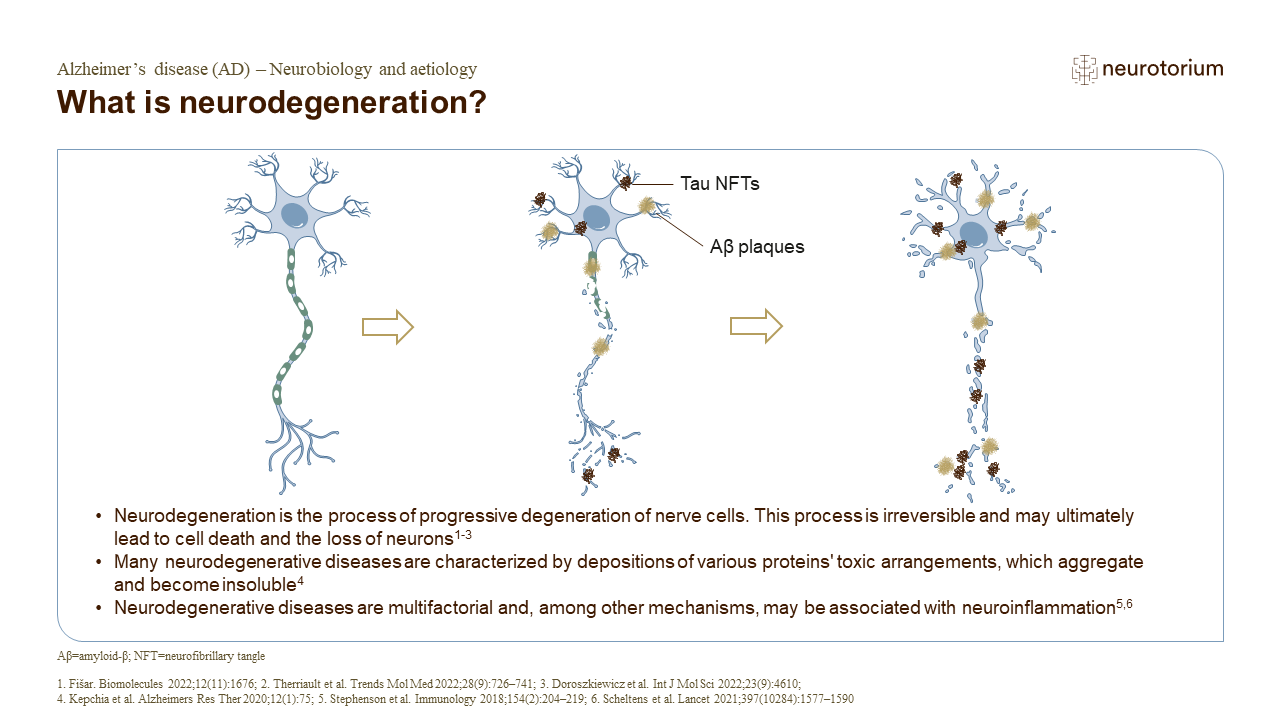
Aβ and tau pathology in AD results in neuroinflammation, mitochondrial dysfunction, metabolic dysregulation, and protein deficiency.1 The resulting neurotoxicity and disturbed neuroplasticity that occur lead to neurodegeneration.1 In vivo, neurodegeneration in AD is identified through several biomarkers such as fluorodeoxy-glucose (FDG)-positron emission tomography (PET), magnetic resonance imaging (MRI) atrophy, and CSF concentrations of total tau and neurofilament light chain.2
References:
1.Fišar Z. Linking the amyloid, tau, and mitochondrial hypotheses of Alzheimer’s Disease and identifying promising drug targets. Biomolecules 2022; 12 (11): 1676.
2.Therriault J, Zimmer ER, Benedet AL, et al. Staging of Alzheimer’s disease: past, present, and future perspectives. Trends Mol Med 2022; 28 (9): 726–741.
3.Doroszkiewicz J, Groblewska M, Mroczko B. Molecular biomarkers and their implications for the early diagnosis of selected neurodegenerative diseases. Int J Mol Sci 2022; 23 (9): 4610.
4.Kepchia D, Huang L, Dargusch R, et al. Diverse proteins aggregate in mild cognitive impairment and Alzheimer’s disease brain. Alzheimers Res Ther 2020; 12 (1): 75.
5.Stephenson J, Nutma E, van der Valk P, Amor S. Inflammation in CNS neurodegenerative diseases. Immunology 2018; 154 (2): 204–219.
6.Scheltens P, De Strooper B, Kivipelto M, et al. Alzheimer’s disease. Lancet 2021; 397 (10284): 1577–1590.