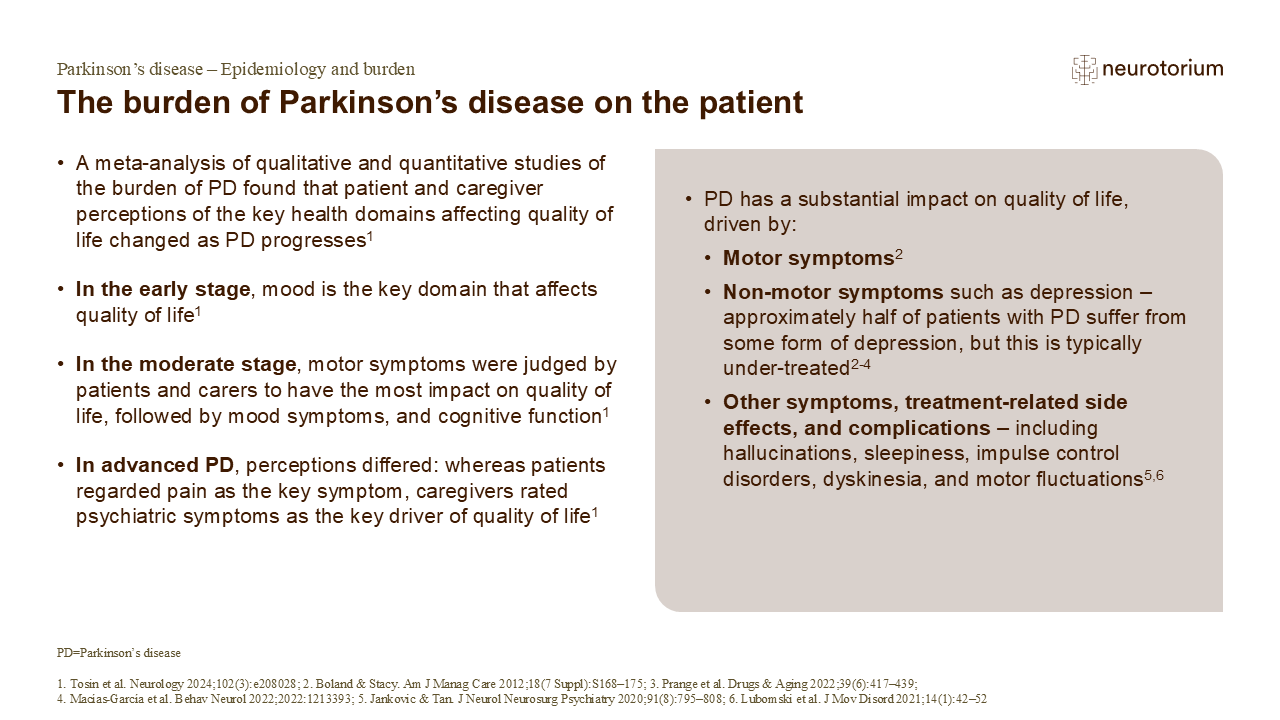
In patients with PD, quality of life can be affected from both a physical and mental health perspective by the classic motor symptoms of the disease, and by certain non-motor symptoms such as depression.2-4 There is evidence to suggest that quality of life is reduced with worsening disease severity, as patients gradually lose their independence and the ability to perform daily tasks.1
References:
1.Tosin MH, Goetz CG, Stebbins GT. Patient with Parkinson disease and care partner perceptions of key domains affecting health-related quality of life: systematic review. Neurology 2024; 102 (3): e208028.
2.Boland DF, Stacy M. The economic and quality of life burden associated with Parkinson’s disease: a focus on symptoms. Am J Manag Care 2012; 18 (7 Suppl): S168–S175.
3.Prange S, Klinger H, Laurencin C, et al. Depression in patients with Parkinson’s disease: current understanding of its neurobiology and implications for treatment. Drugs & Aging 2022; 39 (6): 417–439.
4.Macías-García P, Rashid-López R, Cruz-Gómez ÁJ, et al. Neuropsychiatric symptoms in clinically defined Parkinson’s disease: an updated review of literature. Behav Neurol 2022; 2022: 1213393.
5.Jankovic J, Tan EK. Parkinson’s disease: etiopathogenesis and treatment. J Neurol Neurosurg Psychiatry 2020; 91 (8): 795–808.
6.Lubomski M, Davis RL, Sue CM. Health-related quality of life for Parkinson’s disease patients and their caregivers. J Mov Disord 2021; 14 (1): 42–52.