

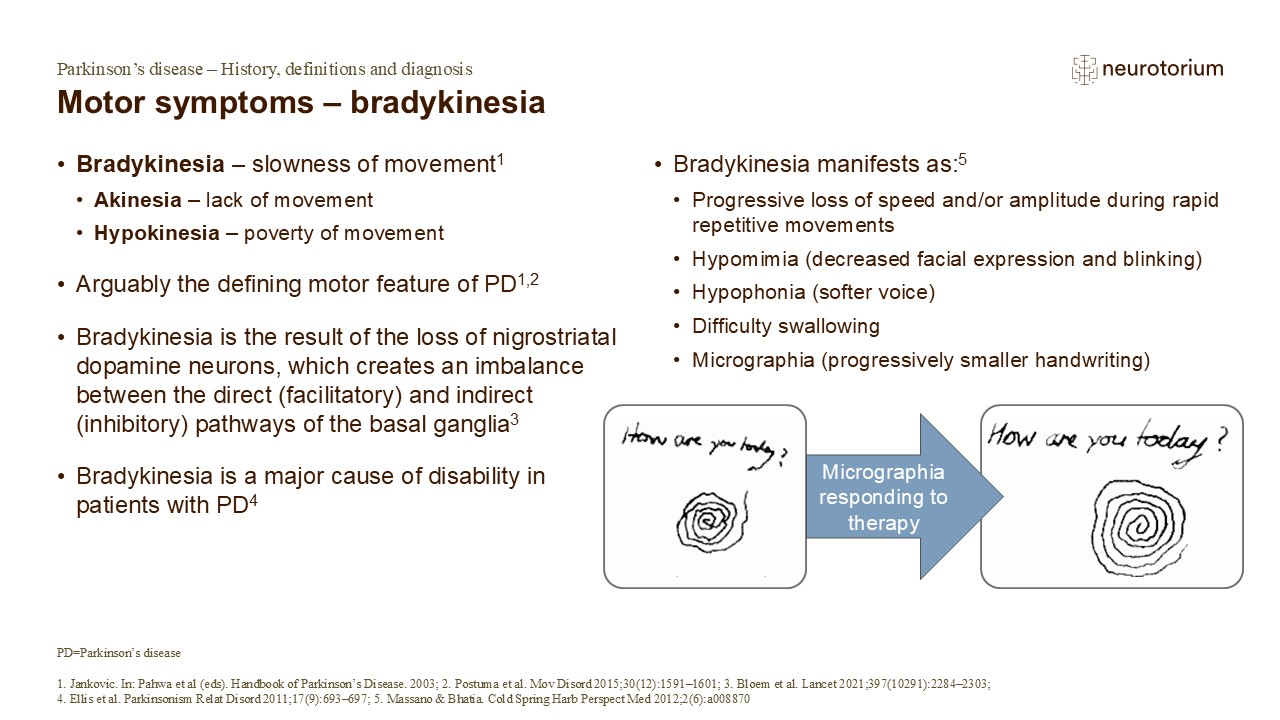
Bradykinesia refers to a slowness of movement.1 Patients with PD often report feeling clumsy or slow, and this may be misinterpreted by family members as a ‘normal’ part of ageing.6 Bradykinesia can manifest in different ways, but it always appears at some point during PD and inevitably worsens as the disease progresses.5,6
Patients with bradykinesia are often limited in their ability to perform repetitive movements, such as tapping their foot on the floor, or opening and closing the hand.5 They typically struggle to maintain both speed and range of motion (‘amplitude’).5 Symptoms tend to be asymmetrical, affecting one side more than the other, so when walking patients with bradykinesia may display reduced arm swing on the more affected side.5,6 Initiation of movement can also be difficult (e.g., when starting to walk),5 and sometimes patients pause mid-movement, causing them to appear frozen.6
Earlier and more subtle signs of bradykinesia may include reductions in spontaneous movement, such as facial expressions (‘hypomimia’), as well as less non-verbal communication through gesticulation.6 The voice may become increasingly soft (‘hypophonia’), and handwriting smaller and more laboured (‘micrographia’).5,7
3.Bloem BR, Okun MS, Klein C. Parkinson’s disease. Lancet 2021; 397 (10291): 2284–2303.
6.Williams DR, Litvan I. Parkinsonian syndromes. Continuum (Minneap Minn) 2013; 19 (5): 1189–1212.