

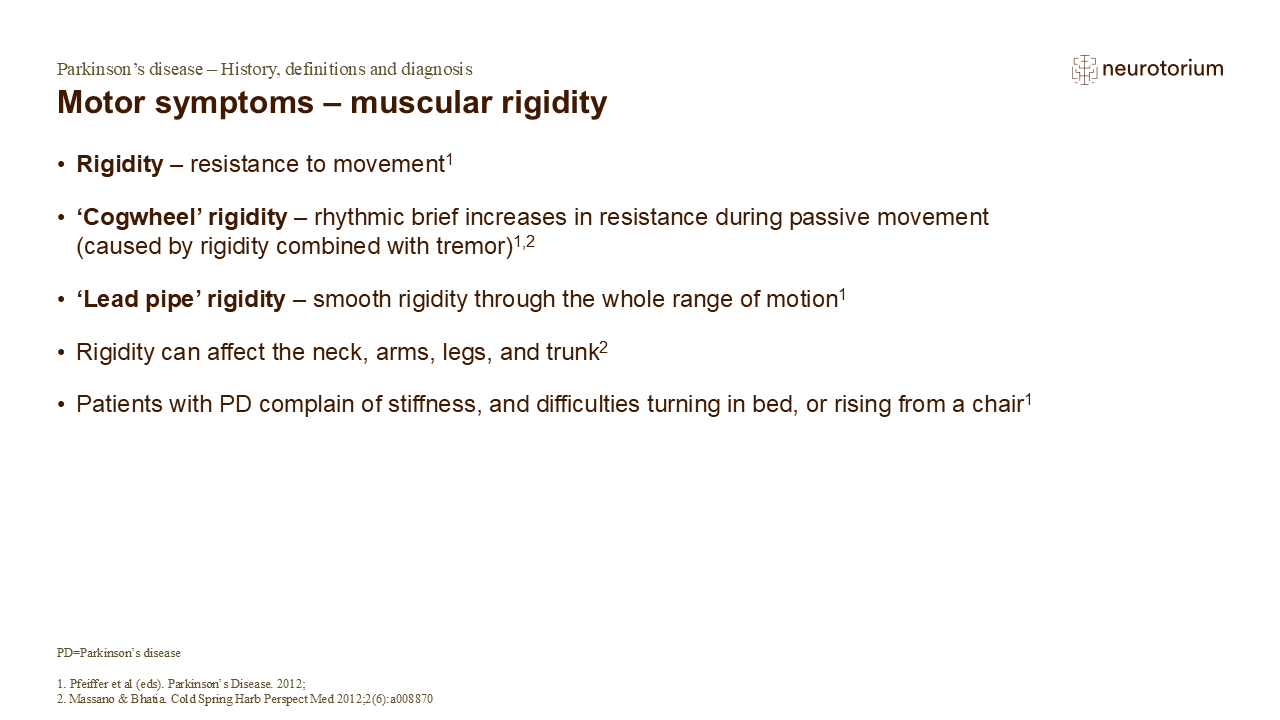
The muscular rigidity or stiffness associated with parkinsonism – sometimes called ‘extrapyramidal rigidity’ – is a key feature of the syndrome.2,3 During the earlier stages of PD, rigidity may manifest solely as pain and can be easily misinterpreted as a musculoskeletal problem, such as a frozen shoulder or degenerative spinal pain.3,4 As PD progresses, movement can become either inconsistent and jerky (‘cogwheel’ rigidity) or consistently stiff throughout the range of movement (‘lead pipe’ rigidity).3 However, this stiffness should always be independent of the velocity of movement, clearly distinguishing it from spasticity, in which resistance is greatest during early acceleration and then gives way (‘clasp knife’ phenomenon).3
References:
1.Pfeiffer RF, Wszolek ZK, Ebadi M. Parkinson’s Disease, 2nd edition. Boca Raton: CRC Press, 2012.
3.Williams DR, Litvan I. Parkinsonian syndromes. Continuum (Minneap Minn) 2013; 19 (5): 1189–1212.