

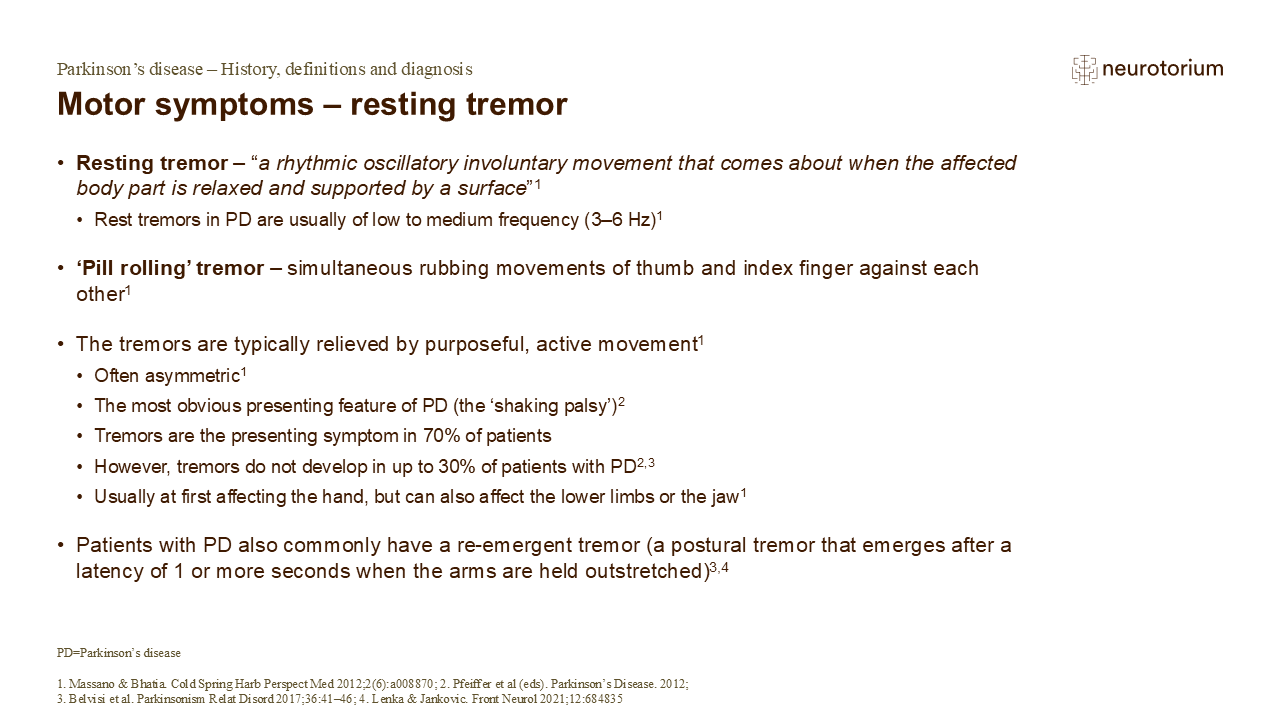
Tremors are a common and highly-visible symptom of PD, typically present when the patient is fully at rest.5 The shaking action tends to be a rhythmic, medium-frequency oscillation.1 It starts when the particular body part is relaxed and supported by a surface, disappears with active movement, and then returns again once movement has ceased (re-emergent tremor).1 Whilst this pattern is normally a tell-tale symptom of parkinsonism, it is not unknown for some patients with PD to present with tremors during active movement (action tremor).5
Tremor occurs mostly in the upper and lower limbs, as well as the tongue and jaw, while head tremor is less common.1 The classic form of resting tremor in patients with PD is the so-called ‘pill-rolling’ action, during which the thumb repeatedly rubs against the index finger.1 Fingers may also repeatedly flex and extend in a tapping-like movement.1
2.Pfeiffer RF, Wszolek ZK, Ebadi M. Parkinson’s Disease, 2nd edition. Boca Raton: CRC Press, 2012.
4.Lenka A, Jankovic J. Tremor syndromes: an updated review. Front Neurol 2021; 12: 684835.