

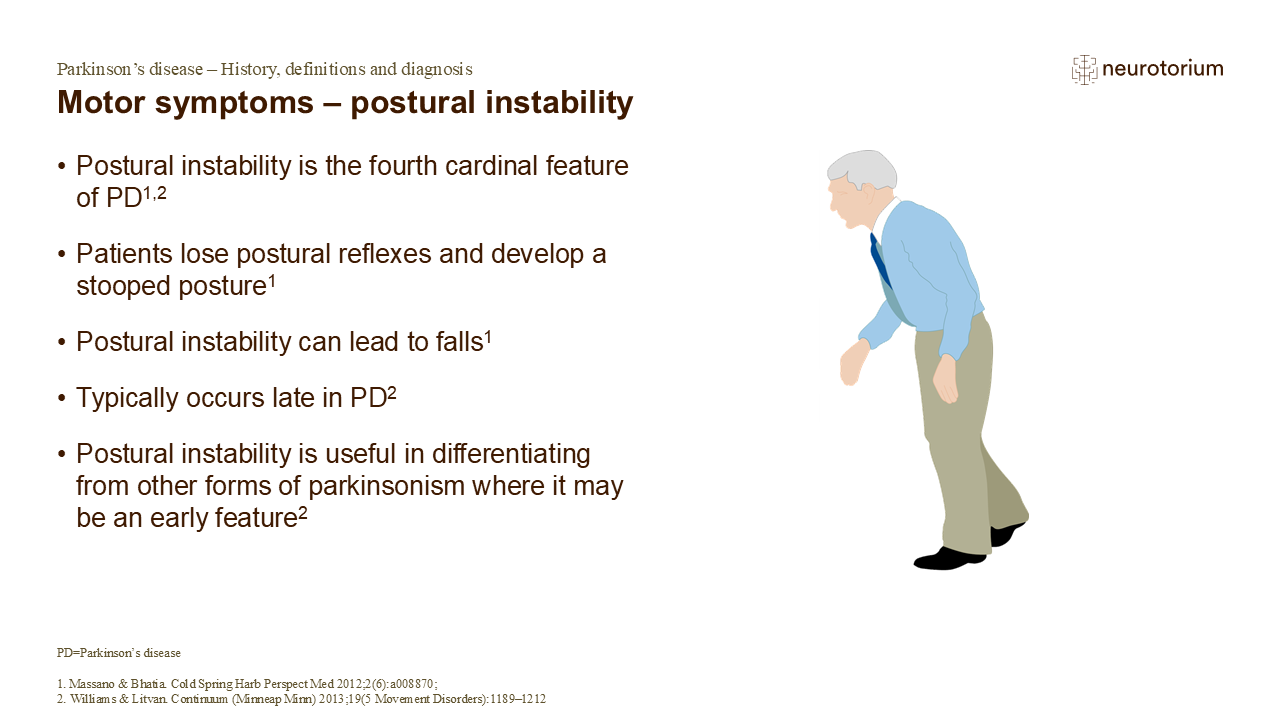
During the progression of PD, the postural reflexes become increasingly impaired as the brain struggles to integrate sensory information about the relative position of various body parts.3 Since this integration is necessary to maintain balance during movement, the loss of the postural reflexes is one of the more disabling symptoms of PD and one of those least responsive to treatment.3 Whereas the cardinal features of PD – bradykinesia, resting tremor, and rigidity – are mainly ascribed to the loss of dopaminergic neurons, those involving posture, balance, and gait are largely secondary to the degeneration of non-dopaminergic pathways, and significantly contribute to impairment and disability in patients with advanced PD.4
Postural instability occurs in approximately 50% of PD patients within five years of diagnosis.5 The loss of postural reflexes is a particularly important symptom of PD because it increases the risk of injuries from falling.1 This can have serious consequences for the ability of a patient to live independently, and can lead to social isolation.3