

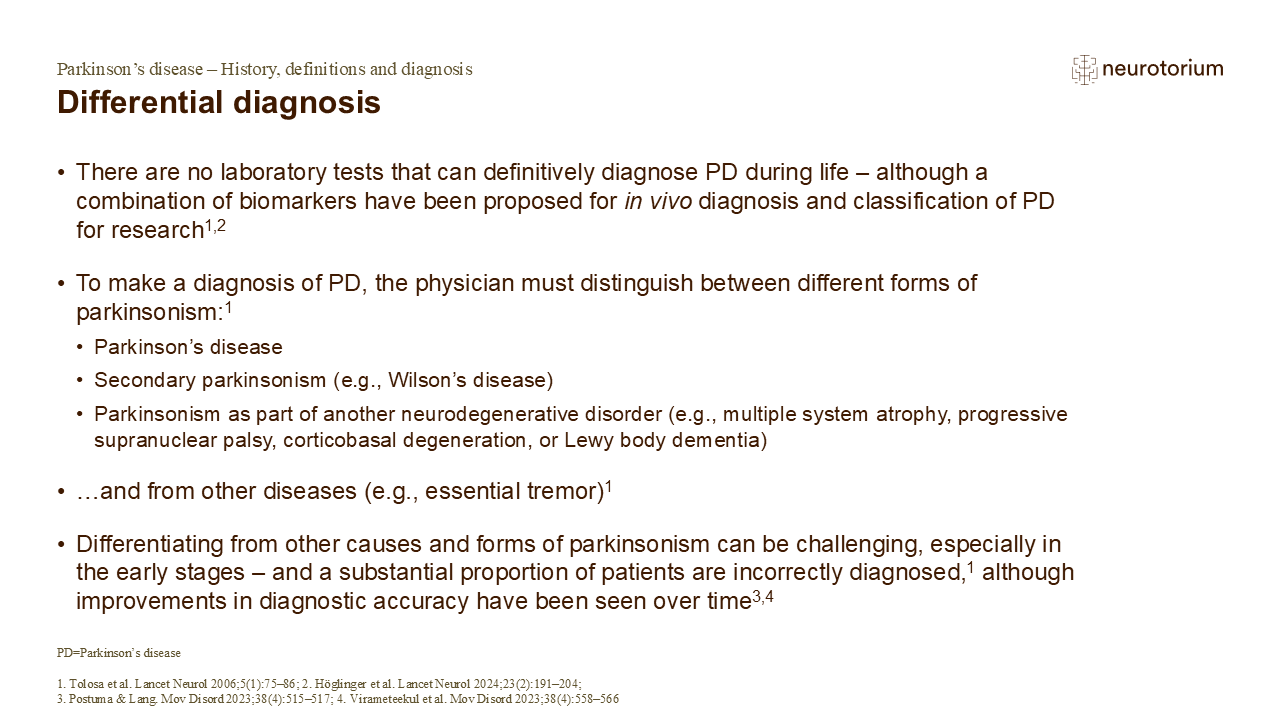
The diagnosis of PD is largely determined by medical history, clinical examination, and response to treatment; there is currently no reliable biochemical, imaging or genetic test that provides a definitive diagnosis.5,6 However, laboratory tests are used in differential diagnosis of other health problems.7
Clinicians tend to diagnose PD incorrectly in approximately 25% of cases,1 although some evidence suggests that this figure has fallen over time, and that diagnostic accuracy is improving, and in some instances can be very good indeed.3,4 A correct diagnosis of PD may be delayed as many of the symptoms could, at first, be confused with the normal process of ageing, or other comorbidities.7 Even when motor symptoms appear, an erroneous diagnosis of Alzheimer’s disease, dementia with Lewy bodies (DLB), or drug-induced parkinsonism might easily be made.1
DLB has similar clinical and neuropathological features to PD, but may be distinguished by the presence of cognitive impairment and hallucinations (unrelated to therapy) early during the disease process.8 There are many other conditions that present with symptoms similar to those of PD, and patients may therefore require expert evaluation to confirm a diagnosis.7
References:
1.Tolosa E, Wenning G, Poewe W. The diagnosis of Parkinson’s disease. Lancet Neurol 2006; 5 (1): 75–86.
6.Williams DR, Litvan I. Parkinsonian syndromes. Continuum (Minneap Minn) 2013; 19 (5): 1189–1212.