

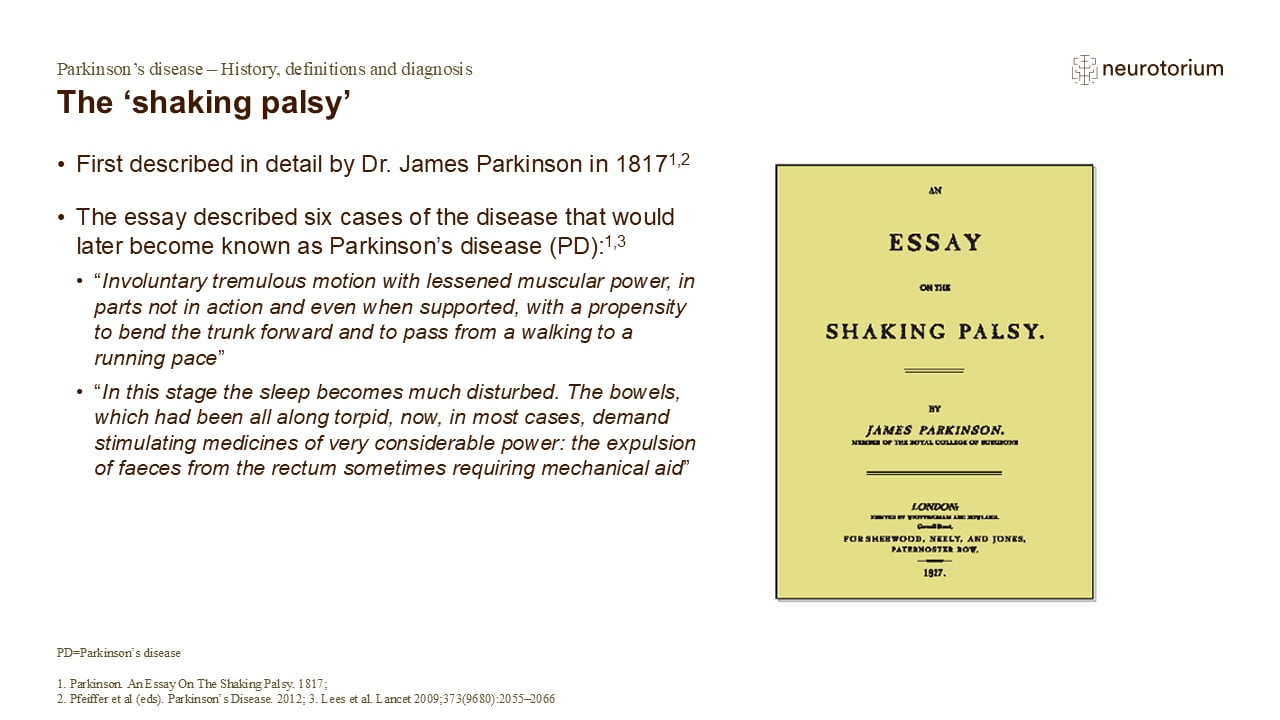
The condition that we now know as Parkinson’s disease (PD) was first described systematically in 1817 by the London surgeon and apothecary James Parkinson.2,3
In his historic essay, Parkinson drew together his observations of several patients who were affected by similar symptoms and disease progression.1 He described their characteristic tremors, gait impairment, stooped posture, and impaired speech, and also included important non-motor symptoms, such as constipation and sleep disorders.1 However, he differed from our modern understanding of PD in believing that the disease did not adversely affect the mind of the patient.1 It is now generally accepted that PD can cause psychiatric problems and cognitive decline, particularly during later phases of the disease.3
Parkinson’s unique contribution to the field was to propose that, despite clear differences between each patient in terms of their individual symptoms and experiences, they had in fact been suffering from a common underlying condition, which he called ‘paralysis agitans’, or the ‘shaking palsy’.1
It was not until several decades after James Parkinson published his essay that the shaking palsy was renamed ‘Parkinson’s disease’ as a tribute to the careful and ground-breaking work that he had carried out (see next slide).2,3
References:
1.Parkinson J. An essay on the shaking palsy. London: Sherwood, Neely and Jones, 1817.
2.Pfeiffer RF, Wszolek ZK, Ebadi M. Parkinson’s Disease, 2nd edition. Boca Raton: CRC Press, 2012.
3.Lees AJ, Hardy J, Revesz T. Parkinson’s disease. Lancet 2009; 373 (9680): 2055–2066.