

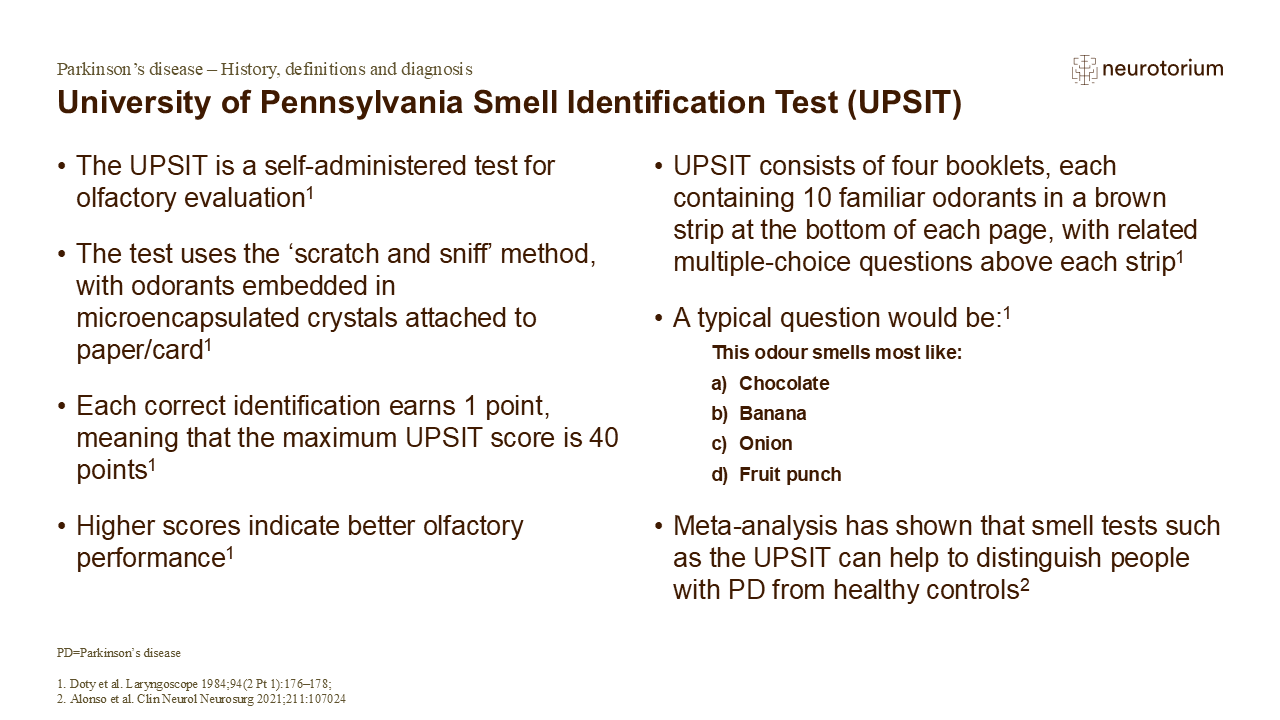
Olfactory dysfunction, known as hyposmia, is very common in patients with PD, and can be an early symptom.3 The University of Pennsylvania Smell Identification Test (UPSIT) was developed at the University of Pennsylvania, to be a valid and useful test of disorders of the chemical senses.1
The UPSIT consists of 4 booklets containing 10 odorants apiece, 1 odorant per page.1 The stimuli are embedded in 10–50 μm diameter microencapsulated crystals located on brown strips at the bottom of each page.1 Above each odorant strip is a multiple-choice question with 4 alternative responses for each item (see the example on the slide).1 The patient is required to answer 1 of the 4 alternatives, even if no smell is perceived.1 The range of odours were chosen to span a range of pleasant and unpleasant smells.1
Scores on the UPSIT scale have been correlated with the degree of neurodegeneration in some areas of the brain linked to PD (specifically hippocampal regions).3 When combined with modern α-synuclein seed amplification assays (α-syn-SAA), the UPSIT can be used as a marker of prodromal PD.4