

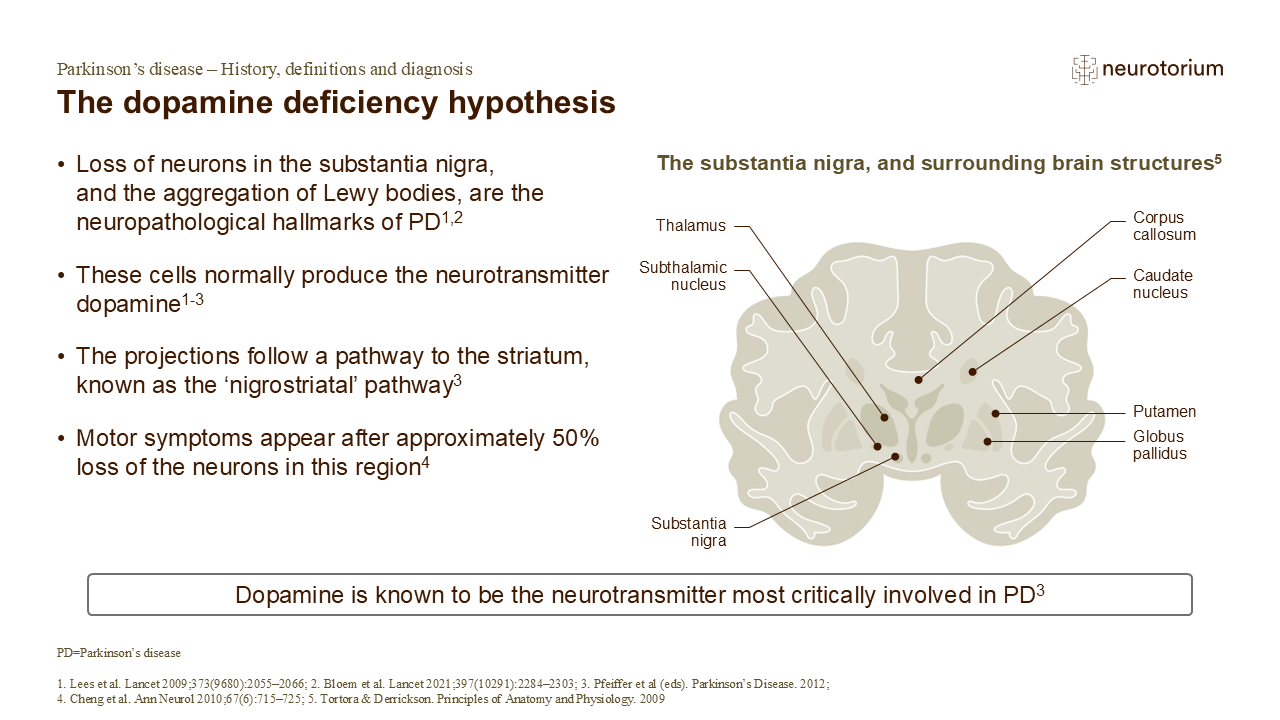
In 1960, scientists showed that brains of PD patients had very low levels of the neurotransmitter dopamine, particularly in the region known as the striatum (comprised of the putamen and the caudate nucleus).6,7 This ‘dopamine deficiency’ appeared to be caused by a marked loss of neurons in the substantia nigra.4
Clinical trials showed that the drug levodopa was effective in relieving PD motor symptoms, increasing recognition that restoring dopamine levels in the brain was likely to be the basis of this mechanism.6 In 1970, levodopa was approved by the US Food and Drug Administration, and it was adopted as the main treatment for PD, which is still the case today.6
We now know that the production of other key neurotransmitters, such as serotonin and noradrenaline, is also reduced in many patients with PD.3,7 So, while dopamine deficiency is certainly a major component of the disease, it is only one of several aspects of brain function affected by this degenerative disorder.3
References:
1.Lees AJ, Hardy J, Revesz T. Parkinson’s disease. Lancet 2009; 373 (9680): 2055–2066.
2.Bloem BR, Okun MS, Klein C. Parkinson’s disease. Lancet 2021; 397 (10291): 2284–2303.
3.Pfeiffer RF, Wszolek ZK, Ebadi M. Parkinson’s Disease, 2nd edition. Boca Raton: CRC Press, 2012.
6.LeWitt PA, Fahn S. Levodopa therapy for Parkinson disease. Neurology 2016; 86 (14): S3–S12.